
Line-interactive vs online double-conversion UPS differences, the pure sine wave requirement for active PFC power supplies, and a VA/watt sizing guide.
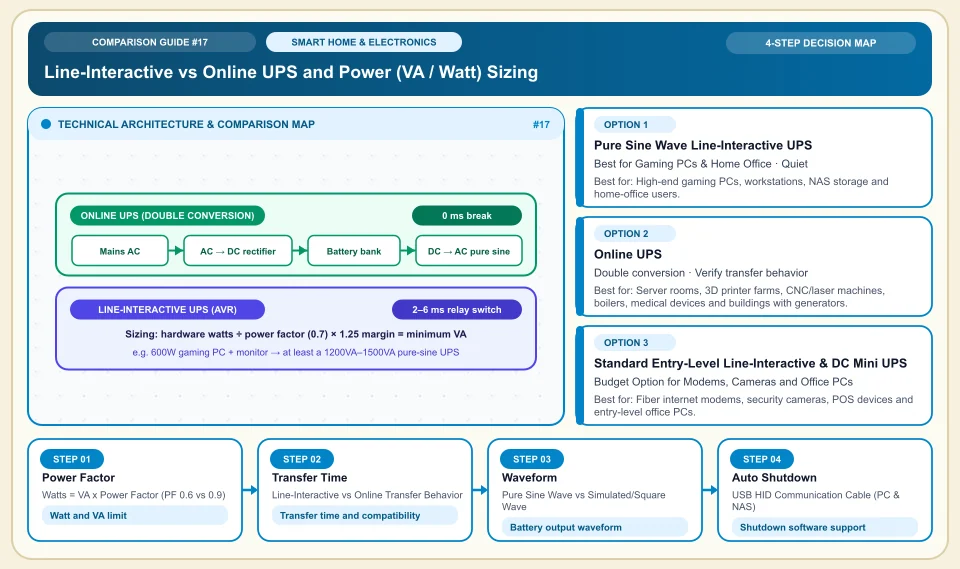
When choosing a UPS, check the VA and watt limits, the output waveform and the runtime you need together.
APC's guide notes that VA and watts are different values and that pure sine wave output gives broad compatibility with active PFC systems. But not every stepped-wave UPS shuts down every computer; compatibility varies by device and load. For medical devices or critical servers, rely on the manufacturer's requirements and a professional design.
Measure the total watt draw of what you will connect and leave headroom under the UPS watt limit.
Check battery runtime on the manufacturer's load curve.
Match pure sine wave and transfer time to your power supply maker's requirement.
Line-Interactive vs Online UPS and Power (VA / Watt) Sizing
Mains fluctuation, relay transfer time, pure sine waveform and the real-watt equation (VA x power factor):
Watts = VA x Power Factor (PF 0.6 vs 0.9)
Match the VA and watt limits to your real load; an example power factor does not apply to every UPS.
Line-Interactive vs Online Transfer Behavior
Line-interactive and online designs switch differently; check the model's technical data.
Pure Sine Wave vs Simulated/Square Wave
Pure sine output can be widely compatible with active PFC systems; the result of a stepped output depends on the load.
USB HID Communication Cable (PC & NAS)
Software that supports USB communication can trigger a shutdown; confirm OS and NAS support.
An Honest Comparison of the Different Types, Pros and Cons
See the bottlenecks that marketing brochures hide, how each type works, and who each architecture suits, side by side:
1. Pure Sine Wave Line-Interactive UPS (APC Gaming / CyberPower PFC / Eaton)
A line-interactive UPS can use AVR while mains is present and switches to battery on an outage; runtime and output waveform depend on the model.
✅ Strengths (pros)
- Some line-interactive models run quietly on mains; fan and alarm noise depend on the product.
- Pure sine output can improve compatibility with active PFC power supplies; test at full load.
⚠️ Weaknesses & limits (cons)
- Transfer time should be assessed for sensitive loads; check the device maker's power requirement.
- Price differences depend on brand, watt capacity and battery features.
High-end gaming PCs, workstations, NAS storage and home-office users.
2. Online (Double-Conversion) UPS (1 kVA - 10 kVA+)
An online double-conversion UPS converts incoming AC to DC and back to AC; how well it rides through mains events depends on the product design.
✅ Strengths (pros)
- Double conversion separates the load from the mains; surge and lightning protection still have to be designed separately.
- The output power factor of double-conversion UPSs varies by model; read the VA and watt labels together.
⚠️ Weaknesses & limits (cons)
- Fan noise depends on the model and mode; check the technical noise figure for your workspace.
- Because of the double conversion, its own power draw and heat output are higher than line-interactive models.
Server rooms, 3D printer farms, CNC/laser machines, boilers, medical devices and buildings with generators.
3. Standard (Simulated Sine) Entry-Level Line-Interactive & DC Mini UPS
On an outage it produces stepped (simulated sine wave) mains-voltage power from the battery; DC mini UPSs plug directly in place of a 12V modem/ONT adapter.
✅ Strengths (pros)
- Very affordable; enough to protect a fiber modem (ONT + router), an NVR security camera and basic office PCs with integrated graphics.
- A mini UPS's modem runtime depends on the modem load and battery capacity.
⚠️ Weaknesses & limits (cons)
- On high-power active PFC computer power supplies, an outage under full load can shut the computer down.
- For motor loads or devices with sudden high current, confirm the manufacturer's load compatibility.
Fiber internet modems, security cameras, POS devices and entry-level office PCs.
Side-by-Side Technical Criteria and Performance Table
The core engineering, cost and usage parameters you can compare directly when deciding:
| Criterion | Pure Sine Line-Interactive | Online (Double-Conversion) | Standard (Simulated Sine) UPS | Verdict |
|---|---|---|---|---|
| Transfer Time | Depends on the model's transfer time | Depends on the double-conversion design | Depends on the model's transfer time | Confirm transfer compatibility in the power supply and UPS documents. |
| Output Waveform | Pure sine wave | Pure sine wave | Stepped (near-square) wave | Pure sine compatibility depends on the power supply and UPS model. |
| Noise (on Mains) | Model-dependent noise level | Model-dependent noise level | Quiet | If it will sit under your desk, an online UPS fan can wear on you. |
| Generator & Dirty Mains | Medium (AVR corrects voltage) | Excellent (also regenerates frequency) | Poor (keeps jumping to battery) | In an industrial area or a workplace with a generator, choose an online UPS. |
| Battery Type & Life | Depends on model and environment | Depends on model and environment | Depends on model and environment | Replacement interval depends on temperature, use and battery type; follow the manufacturer's instructions. |
Providers and reference points
Providers, platforms or official information sources you can weigh against your own needs. The list is not a market-share ranking or a physical product test.
APC by Schneider Electric (Back-UPS Pro Gaming 2200VA & Smart-UPS Series)
- Some APC pure sine models offer power and communication features; verify capacity and noise figures on the product page.
- Weight and price depend on the model and market; check the installation space and current quotes.
Eaton & CyberPower (PFC Sinewave Series)
- CyberPower has pure sine options aimed at active PFC compatibility; verify load and battery runtime from the model data.
- Retail stock availability can be narrower than APC at times, depending on your market.
Category 2: Hardware, Smart Home & Consumer Electronics
Gaming and workstation hardware, 3-2-1 backup and NAS, Matter and Zigbee smart home protocols, 4G solar cameras, robot vacuums, PID espresso, online UPS, 3D printers, camera sensors and Wi-Fi 7 MLO.
Sources and review method
We checked power sizing and sine wave compatibility against the manufacturer's guide; real load, runtime and compatibility must be tested device by device.
Sources checked:
- APC UPS buying guide ↗
Explains the VA-vs-watt difference, power headroom and pure sine wave compatibility; it does not guarantee against shutdowns for every PSU model.
Frequently Asked Questions
Can I plug a laser printer (LaserJet) or a space heater into a UPS?
Laser printers can draw high current while warming up. Before connecting one, check the compatibility limits from both the printer and UPS manufacturers.
I have a computer with a 1000W power supply (PSU); how many VA of UPS should I buy?
First measure the real watt draw of the computer and monitor; use the UPS's watt limit and the manufacturer's runtime curve. Runtime cannot be derived from the VA label alone.
I bought a UPS, but 3 years later it shuts down within 10 seconds of a power cut; is it broken?
Short runtime can come from battery aging, load or a fault. Check the manufacturer's diagnostic procedure and whether a battery replacement through authorized service makes sense.