
A comparison of turret dToF LiDAR, in-body solid-state LiDAR, RGB AI camera obstacle recognition and hot-water mop-washing station robot vacuums (Roborock, Dreame, Narwal).
Choose a robot vacuum by the obstacles and floors in your home, not just a suction number.
Some camera-based robots can recognize objects such as cables, toys and pet waste; iRobot states that this feature exists only on specific models. Brush and mop design matter too, but neither zero tangling nor flawless cleaning is guaranteed in every home. Also weigh privacy and map-data settings.
Compare your home's cables, thresholds and rugs with the chosen model's limits.
Verify obstacle detection and mopping features in the model's own documentation.
Add upkeep consumables, station cleaning and camera privacy to the buying calculation.
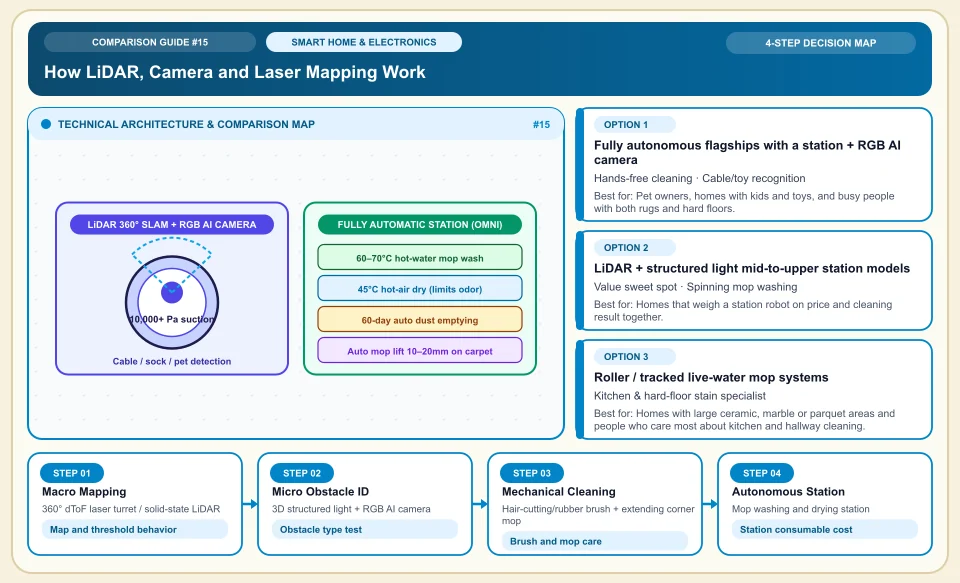
How LiDAR, Camera and Laser Mapping Work
360° laser (SLAM) mapping the room, 3D structured light + RGB AI camera spotting floor cables, and a fully automatic station cycle:
360° dToF laser turret / solid-state LiDAR
LiDAR can provide mapping; map time and small-obstacle detection vary with the home layout.
3D structured light + RGB AI camera
A camera or structured light may recognize some small obstacles; verify from the model which objects it recognizes.
Hair-cutting/rubber brush + extending corner mop
An extendable brush and mop can improve edge reach; corner cleaning should be tested on your floor.
Mop washing and drying station
A station can cut mop washing and drying chores; the tank, bag and brush still need upkeep.
An Honest Comparison of the Different Types, Pros and Cons
See the bottlenecks that marketing brochures hide, how each type works, and who each architecture suits, side by side:
1. Fully autonomous flagships with a station + RGB AI camera (Roborock S8/Saros, Dreame X40/X50, Narwal Freo Z)
Combines LiDAR mapping with a true RGB AI camera, an extending side arm/mop mechanism and a self-cleaning hot-water base station.
✅ Strengths (pros)
- Removes the need to pick up every cable and slipper before vacuuming; it photographs the obstacle and marks it on the map.
- Mop-lift or leave-at-station options vary by model; try them at your rug height.
⚠️ Weaknesses & limits (cons)
- Floor space and overhead clearance for the station should be measured against the chosen model.
- Prices of station models vary by hardware and market.
Pet owners, homes with kids and toys, and busy people with both rugs and hard floors.
2. LiDAR + structured light (no camera) mid-to-upper station models (Roborock Qrevo series, Dreame L10s/L20)
Mapping and the rotating-mop washing/drying station are nearly the same as the flagships, but the front has an infrared 3D line laser instead of a true RGB camera.
✅ Strengths (pros)
- Delivers hot-water mop washing, hot-air drying, dust emptying and mop-lift on carpet for far less than flagship pricing.
- With no real video camera onboard, it is ideal for anyone with even the slightest concern about in-home image privacy.
⚠️ Weaknesses & limits (cons)
- The infrared laser sees mid-size objects like shoes and water bowls, but it is more likely than RGB-camera models to snag on a thin white charging cable or pet waste.
- Small-object recognition in the dark is not as sharp as LED-lit RGB cameras.
Homes that weigh a station robot on price and cleaning result together.
3. Roller / tracked live-water mop systems (Ecovacs X8 / Narwal / Eureka J15)
Instead of a classic spinning or vibrating cloth, it uses a cylinder/track roller mop that sprays clean water as it turns while a scraper pulls dirty water into an internal tank.
✅ Strengths (pros)
- Spilled coffee, sauce or mud is lifted in one pass by a roller that is rinsed every second, rather than smeared around with a cloth.
- Mop pressure may help on stains; real cleaning results depend on the floor and the stain.
⚠️ Weaknesses & limits (cons)
- The robot's own dirty-water tank and roller scraper need rinsing by hand a few times a month (upkeep is a little more detailed than spinning pads).
- On high-pile (shaggy) rugs, mind the climb-height limit compared with models that can leave spinning pads fully in the station.
Homes with large ceramic, marble or parquet areas and people who care most about kitchen and hallway cleaning.
Side-by-Side Technical Criteria and Performance Table
The core engineering, cost and usage parameters you can compare directly when deciding:
| Criterion | LiDAR + RGB AI Camera (Top) | LiDAR + Line Laser (Mid-Upper) | LiDAR-only / VSLAM (Entry) | Engineering verdict |
|---|---|---|---|---|
| Room Mapping Accuracy | Excellent (day/night) | Excellent (day/night) | Good with LiDAR / slow with VSLAM | Do not buy a robot with no laser (LiDAR) on top or in the body. |
| Thin Cable & Sock Recognition | Very high (visual AI) | Medium (sees large objects) | None (drives over/snags) | If cables or toys stay on the floor, an RGB AI camera is a must. |
| Mop Mechanism | Extending spinning pad / roller + hot wash | Spinning pad + wash & dry | Fixed cloth (hand-washed) | A fixed-cloth robot does not mop, it drags a wet wipe; choose a washing station. |
| Carpet Protection | Depends on the model's lift or pad-drop design | Depends on the model's mop-lift height | None (you must detach the cloth by hand) | With thick rugs, buy a model whose mops can detach and stay in the station. |
| Fit Under Low Furniture | Depends on model height | Depends on model height | Depends on model height | Measure the clearance under your sofa and compare it with the robot's real height. |
Providers and reference points
Providers, platforms or official information sources you can weigh against your own needs. The list is not a market-share ranking or a physical product test.
Roborock (Qrevo Curv / Master, S8 MaxV Ultra, Saros Series)
- App, brush and threshold-climbing features vary by model; real use at home is needed to test them.
- On camera-less lower models (Reactive Tech), thin-cable avoidance can trail Dreame and Narwal's dual-camera models.
Dreame (X40 Ultra, X50 Ultra, L40 Ultra)
- A hardware champion with side-brush and mop extension into corners (MopExtend), leaving wet mop pads in the station to vacuum only when climbing onto thick rugs, and TriCut hair-cutting brush options.
- The app menus have a lot of settings; the water tank and station upkeep should be tracked regularly.
Narwal (Freo Z Ultra)
- May offer camera-based obstacle detection and mopping features; detection accuracy should be measured in a home test.
- Its dust bin and deep carpet cleaning power are not as aggressive as its hard-floor/mop performance.
Category 2: Hardware, Smart Home & Consumer Electronics
Gaming and workstation hardware, 3-2-1 backup and NAS, Matter and Zigbee smart home protocols, 4G solar cameras, robot vacuums, PID espresso, online UPS, 3D printers, camera sensors and Wi-Fi 7 MLO.
Sources and review method
We checked the scope of camera-based obstacle recognition against the manufacturer document; suction and mopping results depend on independent home testing. Translated and adapted for an international audience on 2026-11-03.
Sources checked:
- iRobot PrecisionVision obstacle review ↗
Explains obstacle recognition on specific camera-equipped models; it is not proof of cleaning superiority for all robots.
Frequently Asked Questions
Our rugs are thick; will the robot vacuum's wet mop touch them?
For thick rugs, check the mop-lift height and whether the pad can be left in the station in the model documentation.
Can I put regular surface cleaner or bleach in the station's clean-water tank?
Use only the detergent and amount the manufacturer approves; other chemicals can affect seal or pump compatibility.
Do camera robot vacuums watch the inside of my home, and is there a security risk?
Image processing and cloud upload conditions vary by brand and model. Check the privacy notice and the app settings.