
A comparison of solar-panel battery Wi-Fi/4G cameras (eufy, Reolink, Tapo), PIR wake-up delay, the 24/7 recording limit and local HomeBase vs cloud subscription.
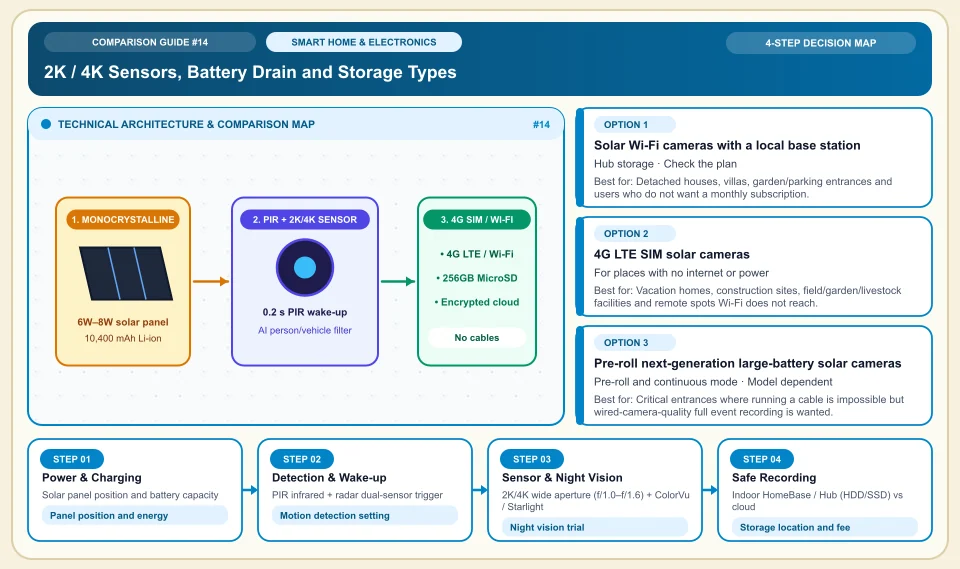
On a battery solar camera, review the recording mode, energy budget and storage location together.
Many battery cameras use motion-triggered recording; Reolink states that some models have exceptions for continuous recording. Giving a market-wide ratio or a specific wake-up time would not be accurate. Verify sunlight, weather, field of view and the storage plan product by product.
If you need continuous recording, check that the model explicitly supports it.
Assess panel position, winter sun and battery capacity at the install site.
Check where recordings stay if the camera is stolen, and the subscription fee.
2K / 4K Sensors, Battery Drain and Storage Types
From solar panel to lithium battery, from PIR thermal trigger to on-device AI and safe indoor storage:
Solar panel position and battery capacity
A detachable panel can face the sun while the camera sits in shade; daily energy yield depends on weather and orientation.
PIR infrared + radar dual-sensor trigger
PIR and radar detection can reduce some false triggers; measure wake-up delay in model tests.
2K/4K wide aperture (f/1.0–f/1.6) + ColorVu / Starlight
Night image quality depends on lighting and sensor design; readable faces or plates are not guaranteed.
Indoor HomeBase / Hub (HDD/SSD) vs cloud
Footage can be kept on a hub or cloud outside the camera; check encryption and the fee plan.
An Honest Comparison of the Different Types, Pros and Cons
See the bottlenecks that marketing brochures hide, how each type works, and who each architecture suits, side by side:
1. Solar Wi-Fi cameras with a local base station (HomeBase / Hub) (eufy, Reolink Home Hub, Tapo Hub)
Solar cameras on the exterior send video over an encrypted low-power link to a base station (HomeBase/Hub) inside the house connected to the router.
✅ Strengths (pros)
- Keeps recordings for years with no monthly cloud fee, and the footage stays inside the house even if the camera is stolen.
- An AI chip on the base station (for example eufy BionicMind) recognizes family faces and cuts needless notifications.
⚠️ Weaknesses & limits (cons)
- Coverage between camera and hub depends on walls, layout and the product; test it at install.
- The upfront price of a multi-camera + HomeBase starter kit is higher than single cameras.
Detached houses, villas, garden/parking entrances and users who do not want a monthly subscription.
2. 4G LTE SIM solar cameras (Reolink Go series, eufy 4G LTE)
A SIM and a solar panel can enable wireless setups in remote areas; power and coverage depend on the carrier.
✅ Strengths (pros)
- Lets you watch live from your phone over orchards, gardens, boats, caravans, construction sites and farmland with no power pole or router.
- Pan-tilt (rotating) 360° and dual-lens (wide-angle + telephoto zoom) models sweep a large area with one camera.
⚠️ Weaknesses & limits (cons)
- Each camera needs an active mobile data (data SIM) plan, and constant live viewing burns through the data allowance fast.
- Recording to an in-camera card raises the risk of loss; mounting height and an offsite recording option should be decided by the install site.
Vacation homes, construction sites, field/garden/livestock facilities and remote spots Wi-Fi does not reach.
3. Pre-roll (ColorX) next-generation large-battery solar cameras
Some models use a large battery and a pre-roll buffer; recording time depends on the product setting and sunlight.
✅ Strengths (pros)
- Models that support pre-roll can save footage from before the motion; duration and trigger conditions depend on the product.
- Some battery models support continuous recording; judge the solar and battery budget within the product's stated limits.
⚠️ Weaknesses & limits (cons)
- The body and solar panel (6W–12W) are larger and heavier than standard palm-sized cameras.
- In sunless winter weeks, continuous recording should be switched off and the camera dropped to smart motion mode.
Critical entrances where running a cable is impossible but wired-camera-quality full event recording is wanted.
Side-by-Side Technical Criteria and Performance Table
The core engineering, cost and usage parameters you can compare directly when deciding:
| Criterion | Solar Wi-Fi with HomeBase | 4G LTE SIM Solar | Pre-Roll / Large-Battery Solar | PoE Wired Camera (Reference) | Engineering verdict |
|---|---|---|---|---|---|
| Recording Type | Motion/AI instant (event-based) | Motion/AI instant | Pre-roll and continuous mode depend on model | Depends on the model's continuous-record conditions | If you can run cable, choose PoE; if not, choose HomeBase/Pre-Roll solar. |
| Footage If Camera Is Stolen | Safe on the in-house hub | Lost with the SD card if cloud is off | Safe if there is a hub/NVR | Safe on the in-house NVR | Weigh an offsite recording option against the risk of camera theft. |
| Fixed Monthly Cost | Depends on local storage and equipment cost | Mobile SIM data plan fee | Depends on local storage and equipment cost | NVR cost and product dependent | Avoid brands that force a cloud subscription (Ring/Arlo). |
| False Alarms (Tree/Cat) | Very low (local AI face/person) | Low (on-device AI filter) | Very low (PIR + AI) | Very low (NVR AI) | Cameras that only watch pixel changes will not stop your phone buzzing in the wind. |
| Solar Panel Placement | Integrated or wired panel | Panel power depends on the product | Panel power depends on the product | Powered via the Ethernet cable | Choose panel position by sunlight; check the manufacturer's temperature limits. |
Providers and reference points
Providers, platforms or official information sources you can weigh against your own needs. The list is not a market-share ranking or a physical product test.
eufy Security (SoloCam S340 / eufyCam S3 Pro + HomeBase 3)
- Some eufy models offer hub storage and different lens options; review capacity and subscription product by product.
- RTSP, ONVIF and NVR support should be verified per model; no single verdict applies to the whole brand.
Reolink (Altas PT Ultra, Argus 4 Pro, TrackMix WiFi/4G)
- Some of Reolink's Altas and TrackMix models offer pre-roll or continuous recording options; verify battery and subscription terms per model.
- The mobile app is not as polished as eufy's, though the technical tuning depth is much greater.
TP-Link Tapo (C425 KIT, C402 Solar)
- Widely available, affordable, easy magnetic mounting and free on-device AI detection of people, pets and vehicles.
- Options for in-camera card and separate hub recording vary by Tapo model; consider the theft scenario.
Category 2: Hardware, Smart Home & Consumer Electronics
Gaming and workstation hardware, 3-2-1 backup and NAS, Matter and Zigbee smart home protocols, 4G solar cameras, robot vacuums, PID espresso, online UPS, 3D printers, camera sensors and Wi-Fi 7 MLO.
Sources and review method
We checked the battery-recording exceptions against the manufacturer support document; solar, battery and detection performance must be measured on site. Translated and adapted for an international audience on 2026-11-03.
Sources checked:
- Reolink battery camera continuous recording ↗
Explains the continuous-recording limits of battery cameras and the exception models; it gives no industry-wide percentages.
Frequently Asked Questions
Is an integrated solar panel on the camera better, or a separate wired panel?
If the camera must sit in shade, detachable panel options can help. Check the cable length and how much sun the panel gets at the install site.
Will the camera shut down if the weather is cloudy and rainy for a week in winter?
Battery life depends on capacity as well as number of motion events, temperature, recording time and sunlight. Compare the manufacturer's test conditions with your own setup.
Does a solar camera charge in freezing cold (-10°C)?
The charging limit at low temperatures depends on the battery chemistry and model. Go by the manufacturer's stated operating and charging temperature range.