
Full-frame, APS-C (Super 35) and Micro Four Thirds sensor sizes; Sony, Canon, Nikon and Fujifilm lens ecosystems; and a 10-bit 4:2:2 video and dynamic range comparison.
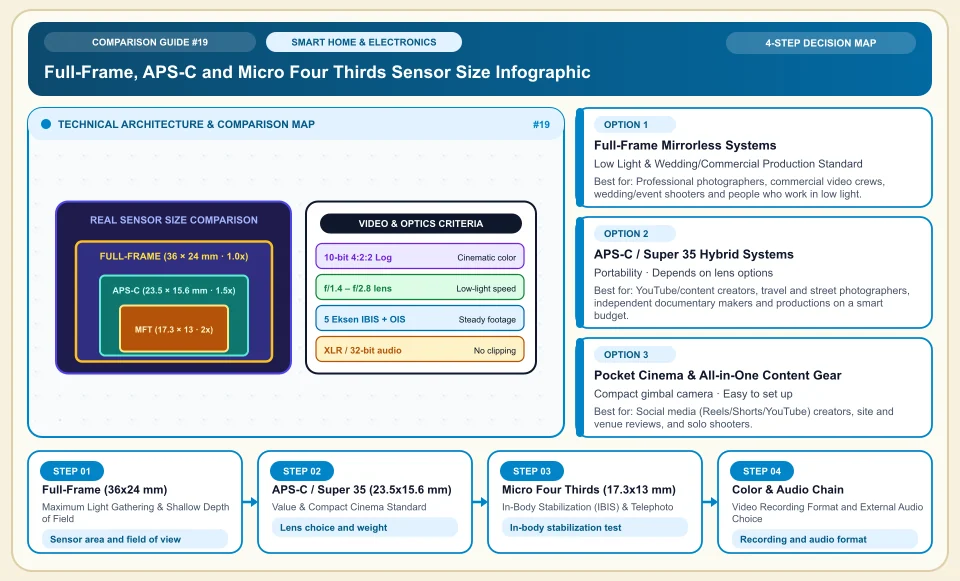
For photo and video gear, think of the sensor, lens, light and audio budget together.
Canon explains the field-of-view and some low-light advantages of a full-frame sensor over APS-C. That does not mean every full-frame camera is sharper or that a given lens always gives a better image. Lens ecosystem, recording format and lighting needs vary with the type of shooting.
Try both systems at the focal lengths and light you actually use.
Add up lens, microphone and light costs together with the body.
Verify the recording format and storage workflow for video color grading.
Full-Frame, APS-C and Micro Four Thirds Sensor Size Infographic
How sensor area directly affects light gathering, depth of field (bokeh) and lens weight and cost:
Maximum Light Gathering & Shallow Depth of Field
A full-frame sensor has a large area; low-light results also depend on pixels, lens and processing.
Value & Compact Cinema Standard
APS-C lens and body weight vary by model; no fixed quality or price ratio can be given.
In-Body Stabilization (IBIS) & Telephoto
In-body stabilization and long-recording performance do not follow from sensor size alone; test model by model.
Video Recording Format and External Audio Choice
Recording bit depth and audio format affect editing flexibility; measure dynamic range and audio quality separately.
An Honest Comparison of the Different Types, Pros and Cons
See the bottlenecks that marketing brochures hide, how each type works, and who each architecture suits, side by side:
1. Full-Frame Mirrorless Systems (Sony A7 IV / A7C II / FX3, Canon R6 II, Nikon Z6 III, Lumix S5 IIX)
A full-frame sensor offers a wider area; noise grain also depends on pixel design, lens and processing conditions.
✅ Strengths (pros)
- A large sensor can bring some low-light and depth-of-field advantages; it depends on the lens and body.
- It is the industry standard for client-facing commercial production, weddings and advertising.
⚠️ Weaknesses & limits (cons)
- Full-frame lens weight and price vary by model; compare the lenses you would choose.
- In close-up product shots depth of field is extremely shallow, so you must stop down (and use more light) to keep the whole product sharp.
Professional photographers, commercial video crews, wedding/event shooters and people who work in low light.
2. APS-C / Super 35 Hybrid Systems (Sony A6700 / FX30, Fujifilm X-T5 / X-S20, Canon R7/R10)
It uses a sensor with a 1.5x crop factor; with palm-sized sharp lenses like the Sigma 18-50mm f/2.8, it combines high quality with a light bag.
✅ Strengths (pros)
- An APS-C body and lens kit can be lighter or cheaper in some setups; get quotes for the specific models you choose.
- Some APS-C bodies offer high-quality video formats; compare against full-frame on the same scene.
⚠️ Weaknesses & limits (cons)
- The low-light gap depends on sensor generation, pixel structure and lens aperture.
- Getting an ultra-wide view (10-12mm) means choosing a dedicated APS-C wide-angle lens.
YouTube/content creators, travel and street photographers, independent documentary makers and productions on a smart budget.
3. Pocket Cinema & All-in-One Content Gear (DJI Osmo Pocket 3 + 32-bit Mic + COB Light)
It combines a 1-inch sensor with a 3-axis mechanical gimbal head and a wireless transmitter mic in a palm-sized package.
✅ Strengths (pros)
- A gimbal and small body can make walking video easier; results depend on light and movement.
- Outdoors it does not draw attention like a big camera and is recording within seconds.
⚠️ Weaknesses & limits (cons)
- It has a fixed wide lens; no optical zoom and the lens cannot be changed.
- It does not replace portrait photography or scenes that need optical telephoto.
Social media (Reels/Shorts/YouTube) creators, site and venue reviews, and solo shooters.
Side-by-Side Technical Criteria and Performance Table
The core engineering, cost and usage parameters you can compare directly when deciding:
| Criterion | Full-Frame Mirrorless | APS-C / Super 35 Mirrorless | 1" Gimbal Camera (Pocket 3) | Verdict |
|---|---|---|---|---|
| Low-Light (Night) Performance | Depends on sensor, lens and processing | Depends on sensor, lens and processing | Depends on sensor, lens and processing | If you shoot at night or in dim scenes, go full-frame; with studio light, APS-C is enough. |
| Body + 2 Quality Lenses Cost | Very high | Depends on body and lens quotes | Low (all included) | Do not spend everything on the camera and have no lens; lens budget comes first. |
| Carry Weight & Travel | Depends on body and lens choice | Depends on body and lens choice | Depends on model weight | The camera you leave at home because it is heavy is the worst camera. |
| Long 4K Recording & Heat | Depends on the model's cooling and recording limits | Depends on the model's cooling and recording limits | High | For long recordings, check the model's heat and power conditions. |
| Third-Party Lens Options | Very wide on Sony E and L-Mount | Very wide on Sony E and Fuji X | Fixed lens | Check lens compatibility by mount and body. |
Providers and reference points
Providers, platforms or official information sources you can weigh against your own needs. The list is not a market-share ranking or a physical product test.
Sony Alpha & Cinema Line (A6700, FX30, A7 IV, A7C II, FX3)
- Sony E-mount has third-party lens options; check compatibility and price lens by lens.
- On some photo bodies the screen/viewfinder resolution and menu ergonomics can feel more technical and cold than rivals.
Canon (EOS R6 Mark II, R8, R7) & Nikon (Z6 III, Z8, Zf)
- Canon stands out for natural skin tones and handling; the Nikon Z6 III / Z8 for built-in RAW video (N-RAW) and a fast partially stacked sensor at this price band.
- Third-party autofocus lens options on the Canon RF full-frame mount are limited, and genuine RF L-series lenses are very expensive.
Fujifilm (X-T5, X-S20, X-M5) & Panasonic Lumix (S5 IIX)
- Fujifilm film simulations and some of Lumix's video features suit different workflows; compare model by model.
- Fujifilm's continuous video autofocus tracking is not as sticky as Sony's; the used market for Lumix is narrower than for Sony/Canon.
DJI (Mic 2, Osmo Pocket 3, RS4 Gimbal) & Røde / Sennheiser + Amaran / Godox
- 32-bit float recording gives level flexibility; it cannot fix mic placement or distortion at the input stage. The effect of lighting depends on the scene.
- It demands discipline: hide the lav mic under clothing instead of showing it, or use a boom mic for desktop shooting.
Category 2: Hardware, Smart Home & Consumer Electronics
Gaming and workstation hardware, 3-2-1 backup and NAS, Matter and Zigbee smart home protocols, 4G solar cameras, robot vacuums, PID espresso, online UPS, 3D printers, camera sensors and Wi-Fi 7 MLO.
Sources and review method
We checked the effect of sensor size against the manufacturer's explanation; image quality should be measured for your lens and lighting combination.
Sources checked:
- Canon full-frame and APS-C sensor comparison ↗
Explains the difference in sensor size and field of view; it does not prove lens sharpness or a price advantage.
Frequently Asked Questions
For YouTube and social media video, should I pick just a body or a whole kit?
Measure your current light and sound conditions; split the body, lens, mic and light budget by the type of shooting.
What does "32-bit float audio recording" in a microphone do, and why does it matter?
32-bit float recording gives flexibility in level setting; it cannot fix distortion in the microphone itself or poor placement.
What is "rolling shutter (jello effect)" in a camera sensor?
The rolling shutter effect depends on sensor readout speed and camera movement. If you shoot a lot of motion, review a sample clip in your own use.