
Bean-to-cup, semi-automatic and capsule espresso machines compared on grinder, temperature control and running cost.
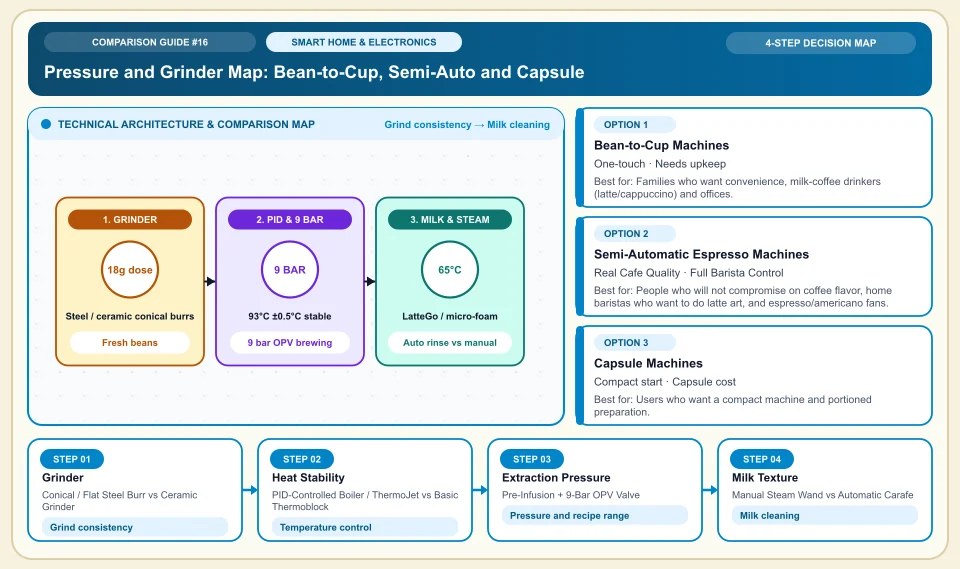
When choosing an espresso machine, look at grind, temperature control and how you will use it, not the pump label.
The Specialty Coffee Association describes classic espresso as roughly 9 bar plus a temperature range; it does not set one correct pressure, temperature or grinder share for taste. The cost of bean-to-cup, semi-automatic and capsule machines depends on how often you use them and which coffee you buy.
Decide how many drinks you make a day and whether you need a grinder.
Judge brew temperature and pressure within the range the product can actually control.
Compare capsule and bean costs against your own yearly consumption.
Pressure and Grinder Map: Bean-to-Cup, Semi-Auto and Capsule
The flavor chain, from grind consistency to PID temperature stability and 9-bar extraction:
Conical / Flat Steel Burr vs Ceramic Grinder
Grind distribution affects extraction; dial in the setting with your beans and recipe.
PID-Controlled Boiler / ThermoJet vs Basic Thermoblock
PID can help hold temperature, but taste does not depend on temperature alone.
Pre-Infusion + 9-Bar OPV Valve
Pre-infusion and pressure adjustment vary by model; judge them together with grind, dose and time.
Manual Steam Wand vs Automatic Carafe
Manual and automatic milk systems need different cleaning and texture control.
An Honest Comparison of the Different Types, Pros and Cons
See the bottlenecks that marketing brochures hide, how each type works, and who each architecture suits, side by side:
1. Bean-to-Cup Machines (Philips, DeLonghi, Jura, Siemens)
At one touch it grinds beans from the hopper, presses them in an internal brew unit, pours the coffee and milk into the cup and drops the used grounds into a bin.
✅ Strengths (pros)
- Gives a consistent latte, cappuccino or americano every time, half asleep or at the office, with no scale, tamper or cleanup of a portafilter.
- Bean and capsule cost depends on brand and volume; compare cost per cup.
⚠️ Weaknesses & limits (cons)
- The cup profile of a bean-to-cup machine depends on its brew group, grind and beans; compare in a blind tasting.
- If the internal mechanism is not rinsed weekly and descaled, it can grow mold or jam.
Families who want convenience, milk-coffee drinkers (latte/cappuccino) and offices.
2. Semi-Automatic (Portafilter) Espresso Machines (Sage/Breville, Gaggia, Rancilio, Lelit)
You put ground coffee in the metal handle (portafilter) and tamp it; the machine pushes PID-controlled hot water through at 9 bar, and you steam the milk yourself with the wand.
✅ Strengths (pros)
- The crema, body and depth of aroma in the cup are well ahead of even the most expensive bean-to-cup machine.
- The portafilter can be easy to clean, though the water path and steam system still need regular maintenance.
⚠️ Weaknesses & limits (cons)
- Semi-automatic brewing takes dialing in the grind and some hand skill; time depends on the user.
- Models without a built-in grinder may need a separate espresso grinder.
People who will not compromise on coffee flavor, home baristas who want to do latte art, and espresso/americano fans.
3. Capsule Machines (Nespresso Original / Vertuo, Tchibo, Dolce Gusto)
It pierces a 5-7 gram aluminum or plastic capsule, ground and sealed under nitrogen at the factory, and pushes pressurized hot water through it.
✅ Strengths (pros)
- Compact capsule machines can be easy to use; warm-up and cleaning time vary by model.
- For light use, pre-portioned capsules can be easy to store; freshness and price vary by product.
⚠️ Weaknesses & limits (cons)
- Coffee per capsule and cost per gram vary by brand; compare your chosen capsule against beans.
- Cost can climb with heavy capsule use; work out capsules versus beans for your own cups per day.
Users who want a compact machine and portioned preparation.
Side-by-Side Technical Criteria and Performance Table
The core engineering, cost and usage parameters you can compare directly when deciding:
| Criterion | Semi-Automatic (Portafilter) | Bean-to-Cup | Capsule Machine | Verdict |
|---|---|---|---|---|
| Espresso Intensity & Flavor | Depends on recipe and brew settings | Depends on grind and recipe | Depends on capsule and machine | If you want real cafe flavor, choose a portafilter semi-automatic. |
| Prep & Cleanup Time | Depends on your routine | Depends on the model's prep time | Depends on the model's warm-up and upkeep | If morning speed matters most to you, bean-to-cup wins. |
| Coffee Cost per Cup | Low (fresh beans) | Depends on bean price and dose | Very high (capsule lock-in) | Work out capsule and bean cost per cup. |
| Hygiene & Upkeep | Very easy (just rinse the handle) | High (internal unit and milk jug need washing) | Very easy (descaling is enough) | Avoid bean-to-cup models whose brew group cannot be removed. |
| Lifespan & Repairability | Depends on upkeep and parts | Depends on upkeep and parts | Depends on upkeep and parts | Brass/steel-boiler semi-automatics can keep running for generations. |
Providers and reference points
Providers, platforms or official information sources you can weigh against your own needs. The list is not a market-share ranking or a physical product test.
DeLonghi (Magnifica Evo / Dinamica Plus / Eletta Explore) & Philips (LatteGo Series)
- Philips and DeLonghi models offer different milk systems, grinders and upkeep features; check cleaning time for the specific model.
- Philips' ceramic grinder runs a little louder, and its coffee body is a notch softer than DeLonghi's.
Sage / Breville (Barista Express Impress, Bambino Plus) & Lelit / Gaggia
- Warm-up, temperature and milk features differ across Sage, Lelit and Gaggia; compare machines model by model.
- The Bambino series needs a separate espresso grinder (e.g. Baratza Encore ESP / DF54 / Eureka Mignon).
Jura & Siemens (EQ Series)
- With its P.E.P. pulse extraction, Jura gives the espresso closest to a semi-automatic among bean-to-cup machines; the Siemens EQ series is very quiet.
- On Jura machines the internal brew unit cannot be pulled out and rinsed under the tap; it is cleaned in a closed loop with special tablets, and service costs are high.
Category 2: Hardware, Smart Home & Consumer Electronics
Gaming and workstation hardware, 3-2-1 backup and NAS, Matter and Zigbee smart home protocols, 4G solar cameras, robot vacuums, PID espresso, online UPS, 3D printers, camera sensors and Wi-Fi 7 MLO.
Sources and review method
We checked the espresso pressure and temperature range against the SCA source; taste and total cost of ownership vary with the coffee, the machine and how much you drink.
Sources checked:
- Specialty Coffee Association espresso definition ↗
Reports a definition of roughly 9 bar and a temperature range, plus survey results; it gives no single correct recipe or flavor percentage.
Frequently Asked Questions
What is a "pressurized basket" in cheap entry-level semi-automatic machines?
It is a double-walled basket with a single pinhole in the bottom; it produces artificial foam (fake crema) even with thick pre-ground supermarket coffee. When you want real espresso aroma, pair the machine with a good grinder and switch to a non-pressurized (single wall) basket.
What happens if I use tap water in a coffee machine?
Water hardness affects scale buildup in the machine. Follow the manufacturer's water and descaling instructions.
Is it harmful to use oily (dark roast) beans in a bean-to-cup machine?
Oily or flavored beans can build up in some automatic grinders; check the model's bean and cleaning recommendations.