
Comparing Search Console, competitor estimation tools and technical crawlers by data coverage and cost.
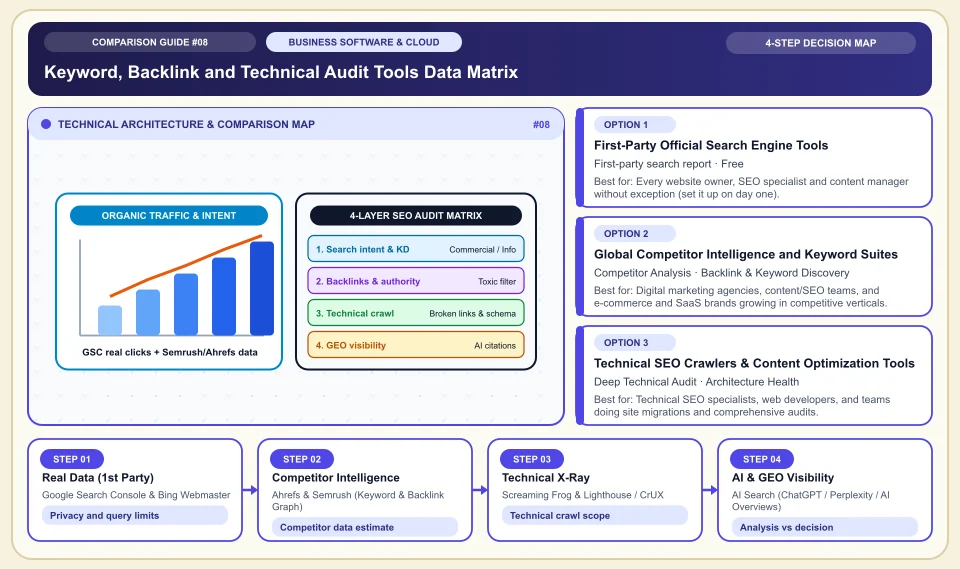
Read SEO data together with its source and reporting limits.
Search Console provides Google Search impression and click data; for privacy it hides anonymized queries and limits some tables. For that reason no combination of tools gives one hundred percent complete data. Compare competitor tools' traffic and link estimates with their methods, and your own analytics data with its measurement scope.
Interpret the difference between Search Console query totals and chart totals in the context of data limits.
GA4 and Search Console measure different things; do not equate their numbers one to one.
Label competitor research tools as estimate generators and evaluate technical crawling separately.
Keyword, Backlink and Technical Audit Tools Data Matrix
How tasks divide among first-party search engine telemetry, third-party competitor bot crawling and local technical crawler layers:
Google Search Console & Bing Webmaster
Search Console data comes directly from Google Search; anonymized queries and row limits apply.
Ahrefs & Semrush (Keyword & Backlink Graph)
Reveals competitors' top-traffic pages, lost rankings and where they get guest posts or links.
Screaming Frog & Lighthouse / CrUX
Crawls your site from start to finish just like Googlebot, checking 404 errors, redirect chains, noindex traps and JSON-LD schemas.
AI Search (ChatGPT / Perplexity / AI Overviews)
Beyond classic blue links, tracks whether your brand is shown as a source (citation) in AI answers.
An Honest Comparison of the Different Types, Pros and Cons
See the bottlenecks that marketing brochures hide, how each type works, and who each architecture suits, side by side:
1. First-Party Official Search Engine Tools (Google Search Console, GA4, CrUX)
Fed directly by the real measurement database of the Google search engine and Chrome browser users (CrUX).
✅ Strengths (pros)
- Not an estimate or a model: a one-to-one record of the searches and clicks that actually happened.
- Gives the indexing status of newly published pages, sitemap errors and real-user speed (Core Web Vitals) for free.
⚠️ Weaknesses & limits (cons)
- Shows data only for your own verified property; you cannot access competitor sites.
- Retention and export terms for Search Console reports should be checked against the current product.
Every website owner, SEO specialist and content manager without exception (set it up on day one).
2. Global Competitor Intelligence and Keyword Suites (Ahrefs, Semrush, SE Ranking)
Produces competitor traffic estimates from commercial crawlers and keyword datasets; coverage and freshness vary from tool to tool.
✅ Strengths (pros)
- Gives an idea of competitor content and estimated traffic; query and share results are not independent measurement.
- Catches low-difficulty (low KD), high-intent keywords and broken backlink opportunities that nobody has noticed yet.
⚠️ Weaknesses & limits (cons)
- Monthly subscription fees are high; in particular, Ahrefs' credit-based usage limit can produce an extra bill if used carelessly.
- For small, niche searches in less common languages, monthly volume estimates can look far below real Search Console impressions (the zero-volume fallacy).
Digital marketing agencies, content/SEO teams, and e-commerce and SaaS brands growing in competitive verticals.
3. Technical SEO Crawlers & Content Optimization Tools (Screaming Frog, Sitebulb)
Runs on your computer and maps the target site's full HTML, CSS, JS, HTTP headers and internal link tree down to the millimeter.
✅ Strengths (pros)
- A technical crawl helps find canonical, redirect and meta issues; whether it catches every URL depends on crawl scope.
- Free usage and license limits should be checked in the product's current plan.
⚠️ Weaknesses & limits (cons)
- Has no keyword search volume or competitor backlink database; it is a pure technical audit tool.
- Crawling huge sites with millions of pages needs a lot of RAM on your computer.
Technical SEO specialists, web developers, and teams doing site migrations and comprehensive audits.
Side-by-Side Technical Criteria and Performance Table
The core engineering, cost and usage parameters you can compare directly when deciding:
| Criterion | Google Search Console | Ahrefs | Semrush | Screaming Frog | Engineering Decision |
|---|---|---|---|---|---|
| Accuracy of your own site's traffic | First-party data; privacy and table limits apply | Estimated, depends on method and sampling | Estimated, depends on method and sampling | Pulls via GSC/GA4 API | For your own site, interpret Search Console and analytics coverage together. |
| Backlink & competitor link discovery | Only your own links | Index coverage varies by product | Very strong | None | For link and competitor analysis, compare index coverage. |
| Google Ads (PPC) & market analysis | None | Basic level | Industry leader (ad copy/budget) | None | Semrush is more comprehensive for agencies running both SEO and Google Ads. |
| Technical SEO & code crawling | Index & CWV errors | Cloud site audit (credits) | Cloud site audit | Deepest (JS render + XPath) | Run a technical check with Screaming Frog before going live. |
| Cost / accessibility | Basic access free; extras differ | High (monthly + credits) | High (monthly package) | Verify the current license quota | On a tight budget, the GSC + Screaming Frog + SE Ranking trio is the smartest. |
Providers and reference points
Providers, platforms or official information sources you can weigh against your own needs. The list is not a market-share ranking or a physical product test.
Google Search Console (GSC) + BigQuery Export
- Provides Google Search query, impression and click reports; anonymized queries and data truncation are limitations.
- Interface and API query row limits apply; anonymized queries are not shown even in the export.
Ahrefs
- Has the world's most active web crawler after Google (AhrefsBot); shows with the cleanest interface which pages a competitor gets links and organic traffic from.
- The credit-consuming pricing model for opening and filtering reports raises cost for heavy-use teams.
Semrush
- Alongside organic SEO analysis, offers a competitor's Google Ads copy, local SEO (maps) status and a content writing assistant under one roof.
- The many tools and submenus in the interface can distract first-time users; extra user seats are expensive.
Screaming Frog SEO Spider
- Audits a site's whole URL tree, HTTP status codes, canonical conflicts, custom XPath/Regex extractions and JSON-LD schemas within minutes.
- It is desktop software; sending automated weekly client reports via the cloud needs extra configuration.
Category 1: Business Software, Cloud & B2B Infrastructure
Cloud server architecture, website builders, AI developer tools, CRM, business communication, project management and SEO decision matrices.
Sources and review method
We checked the privacy and reporting limits in Google's primary documentation; tool rankings are not measured performance results. Translated and adapted for an international audience on 2026-11-03.
Sources checked:
- Search Console Performance data limits ↗
Explains how anonymized queries are hidden and row limits apply; it does not provide full data coverage.
- Search Console query limitations ↗
Explains missing query rows caused by privacy and data truncation.
Frequently Asked Questions
Does it make sense to write about a keyword that shows "Search Volume: 0" in Ahrefs or Semrush?
Yes. A tool showing zero volume does not mean nobody searches for it. Search Console also does not provide a full query list because of query anonymization and table limits.
Where should I look first when I see my site losing rankings on Google?
First examine comparable periods and pages in Search Console; then check technical crawls and content changes. Do not jump to a single cause.
How should I use SEO tools to get recommended in AI searches (ChatGPT, Perplexity, Gemini)?
When generating answers, AI models look not only at keyword density but at clear comparison tables, structured JSON-LD schema markup and whether your brand is mentioned in reliable third-party sources (digital PR).