
Air-source (monobloc vs split) and ground-source heat pumps compared: underfloor heating vs old radiators, R32 vs R290 refrigerant, and winter COP.
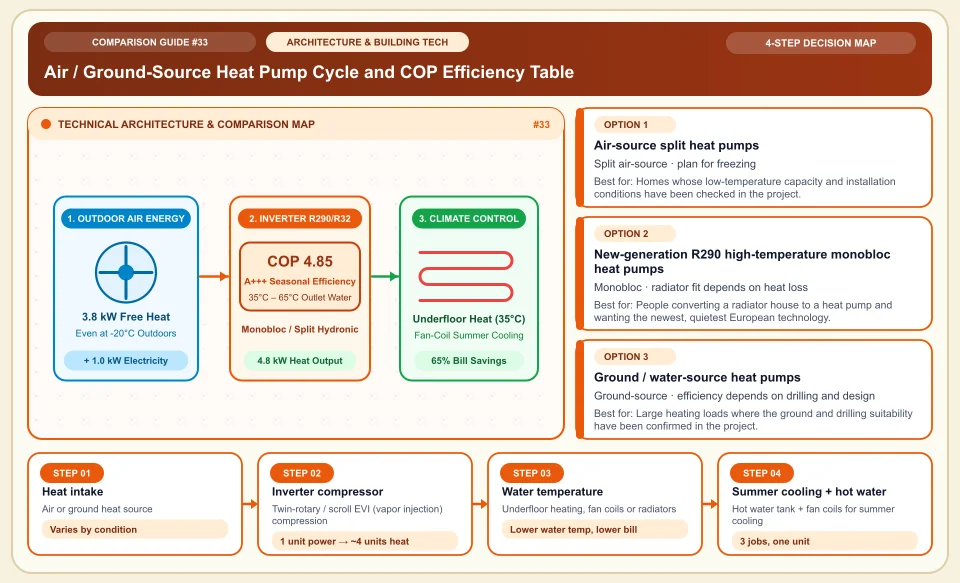
A heat pump's efficiency depends on outdoor air and heating water temperature, so don't pick a unit from a single COP figure in the catalog.
Choosing a heat pump means looking at the building's heat loss, the local design temperature, the water temperature your existing emitters need, and the maker's low-temperature capacity tables together. No single unit or fixed ratio guarantees your electricity use or comfort.
Read the catalog COP together with the test condition it was measured under, and ask for the capacity table at your local winter temperature.
In a new build or renovation, design the heat pump together with emitters that work at low water temperature.
For existing radiators, check the required supply temperature with a heat-loss calculation and product data. Don't choose by refrigerant name alone.
Air / Ground-Source Heat Pump Cycle and COP Efficiency Table
How heat from air or ground gets moved into the heating loop, and the different test conditions:
Air or ground heat source
A very low boiling-point refrigerant in the outdoor unit evaporates by pulling heat even from cold outside air.
Twin-rotary / scroll EVI (vapor injection) compression
The compressor cycle moves heat in from outside. Real COP changes with outdoor, source and outlet water temperature.
Underfloor heating, fan coils or radiators
The water temperature an emitter needs is calculated from the building's heat loss and the emitter surface area.
Hot water tank + fan coils for summer cooling
The same unit makes hot water all year and, in summer, sends cool water through fan coils to cool the house like an air conditioner.
An Honest Comparison of the Different Types, Pros and Cons
See the bottlenecks that marketing brochures hide, how each type works, and who each architecture suits, side by side:
1. Air-source split heat pumps (indoor + outdoor unit; Daikin Altherma, Mitsubishi Zubadan, Vaillant, Viessmann)
Between the outdoor unit and the hydraulic indoor unit, a refrigerant gas (R32) circulates rather than water. The water is only heated inside the warm house.
✅ Strengths (pros)
- Freeze risk for the outdoor water line differs from a monobloc. All outdoor components should still be reviewed in the project.
- The circulation pump, expansion tank and hot water tank are built into the indoor unit (all-in-one), so the plant room stays tidy.
⚠️ Weaknesses & limits (cons)
- Copper piping, vacuuming and gas charging must be done carefully by a certified HVAC technician.
- The outlet water temperature you can reach depends on the model and outdoor conditions.
Homes whose low-temperature capacity and installation conditions have been checked in the project.
2. New-generation R290 (propane) high-temperature monobloc heat pumps (Vaillant aroTHERM plus, Viessmann Vitocal 250-A, Bosch, Panasonic)
In a monobloc the refrigerant cycle sits entirely in the outdoor unit. Freeze protection for the water line is set by the design and installation.
✅ Strengths (pros)
- Whether existing radiators suit it should be verified against the required water temperature and the model's winter capacity table.
- There is no gas pipe inside the house, only a water connection made by the plumber, and the new acoustic housings are whisper quiet.
⚠️ Weaknesses & limits (cons)
- Freeze protection for the outdoor water lines must be designed for the local climate and the install instructions.
- Upfront cost depends on the model, capacity and installation quote.
People converting a radiator house to a heat pump and wanting the newest, quietest European technology.
3. Ground / water-source (geothermal) heat pumps (Nibe, Viessmann, Rehau)
In a ground-source system, heat exchange depends on geology and the sized underground loop.
✅ Strengths (pros)
- The ground loop offers a different source temperature than outside air. Real efficiency depends on the drilling and plumbing design.
- A ground-source system may not need an outdoor fan. Unit and loop lifespan depend on the product and maintenance.
⚠️ Weaknesses & limits (cons)
- Drilling a borehole or burying a large ground coil makes the upfront budget about 2–2.5 times that of an air-source system.
- Needs a large yard or a drilling permit.
Large heating loads where the ground and drilling suitability have been confirmed in the project.
Side-by-Side Technical Criteria and Performance Table
The core engineering, cost and usage parameters you can compare directly when deciding:
| Criteria | R32 split heat pump (35°C underfloor) | R290 monobloc (65°C radiators) | Ground-source (with drilling) | Electric boiler (resistance) | Engineering call |
|---|---|---|---|---|---|
| Heating efficiency | Depends on outdoor air and water temperature | Depends on outdoor air and water temperature | Depends on ground loop and water | Runs on electric resistance | Compare COP tables at the same test condition. |
| Outlet water | Depends on the model data sheet | Depends on the model data sheet | Depends on the model data sheet | Depends on the unit data sheet | Radiator adequacy is calculated from heat loss. |
| Cold weather | Check low-temperature capacity | Check low-temperature capacity | Depends on ground loop design | Depends on load and electrical capacity | Compare heating load at your local design temperature. |
| Freezing in an outage | Depends on outdoor components | Depends on outdoor water line protection | Depends on loop design | Depends on where it's installed | Design freeze protection with the maker. |
| Cost and payback | Depends on quote and energy price | Depends on quote and energy price | Depends on drilling and energy price | Depends on energy price | Don't assume a fixed payback or free heating. |
Providers and reference points
Providers, platforms or official information sources you can weigh against your own needs. The list is not a market-share ranking or a physical product test.
Daikin (Altherma 3 / 4 series) & Mitsubishi Electric (Ecodan / Zubadan)
- Compare local service, spare parts and low-temperature capacity for the specific Mitsubishi and Daikin model you choose.
- With the original hot water tank and room thermostat accessories, the total package price is higher than alternatives from other makers.
Vaillant (aroTHERM plus R290), Viessmann (Vitocal 250-A / 200-S) & Bosch / Buderus
- Check the outlet water temperature and sound performance of R290 ranges against the test conditions of the exact model.
- Top-segment pricing. They should be protected with a surge protector and a water conditioning filter (magnetic dirt separator).
Panasonic (Aquarea T-CAP), Toshiba (Estia), Gree (Versati) & Midea
- Compare cold-air capacity across makers using data sheets at the same test condition. Don't assume a fixed price advantage.
- When choosing a budget model, always check the Eurovent-certified −7°C capacity table. Do not size a small unit from the warm-air kW figure on paper.
Category 4: Architecture, Building & Living Spaces
In-room soundproofing, R290 heat pumps, reverse-osmosis water purifiers, hydroponic farming, ergonomics, solar low-E facades and smart irrigation.
Sources and review method
The DOE sizing guide uses local climate, heating load and the maker's capacity tables together. COP and electricity use should be calculated for your installation conditions.
Sources checked:
- DOE — Guide to Sizing and Selecting Air-Source Heat Pumps ↗
Choosing heat loss and unit capacity based on local design conditions.
Frequently Asked Questions
How do I choose the right heat pump capacity for a house?
A unit that is too big or too small can cause efficiency and comfort problems. Review the design heat loss, your local winter conditions and the maker's part-load data with a specialist. Don't expect a fixed bill change or a fixed fault rate.
Does it make sense to remove a gas boiler and switch to a heat pump where gas is available?
Work out running cost using current electricity and gas tariffs, the building heat demand, your climate and the unit's seasonal efficiency. Having solar panels does not by itself guarantee a low bill or the cheapest solution.
Why does my heat pump's outdoor unit give off steam and drip water in winter?
In cold, humid conditions the outdoor unit may run a defrost cycle. How often, how much water and the drainage needed vary with the unit and weather. Follow the maker's installation instructions.