
Reverse osmosis (0.0001 micron membrane), NSF/ANSI 58 certification, tank vs direct-flow (tankless) units, and the "12-stage filter" marketing trick.
For a home water purifier, look at what your drinking water actually contains and which contaminants the unit is certified to remove, not at the number of stages.
Taste, smell or appearance alone doesn't show that water is safe. Test your water first. If needed, choose a filter matched to the target contaminant with certification you can verify. Reverse osmosis should not be presented as mandatory or the healthiest option for every home.
A 5- or 6-stage system (sediment + activated carbon + carbon block + RO membrane + polishing carbon + optional real remineralization) is a solid standard. Stay away from 10–14-stage showy packages.
Verify the compliance documents for each part that touches water: filter housing, tank, faucet and so on.
Compare the waste-water ratio with the unit's certified test conditions and your home's water pressure.
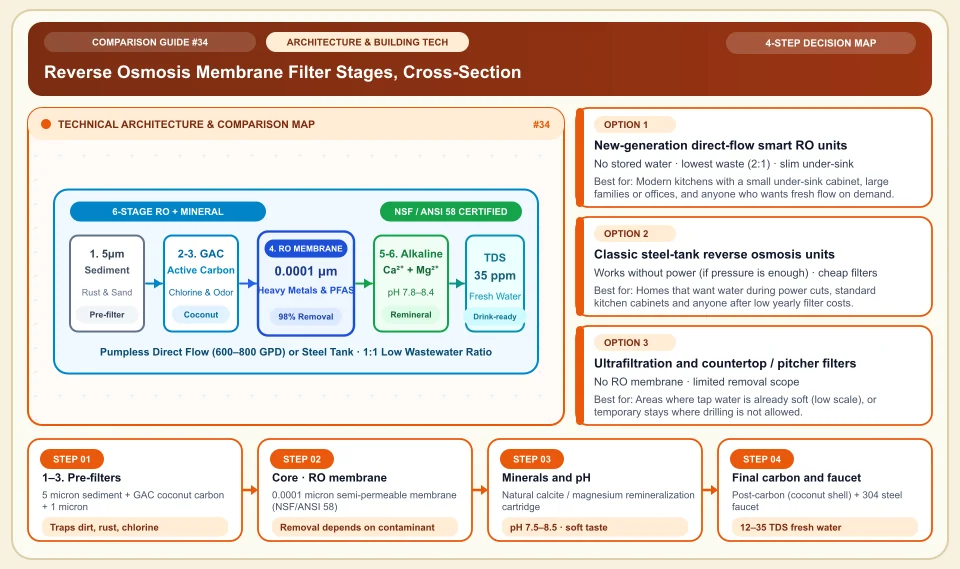
Reverse Osmosis Membrane Filter Stages, Cross-Section
Six core stages that take tap water from 5 microns down to 0.0001 micron (everything bigger than a water molecule is removed):
5 micron sediment + GAC coconut carbon + 1 micron
What the sediment and carbon filters remove is defined by the test scope in the product certificate.
0.0001 micron semi-permeable membrane (NSF/ANSI 58)
Under pressure, only water molecules pass. Scale, nitrate, lead, arsenic, PFAS, microplastics and bacteria are sent out through the waste line.
Natural calcite / magnesium remineralization cartridge
Puts back, in a controlled way, the calcium and magnesium ions that give water its taste after it leaves the membrane pure.
Post-carbon (coconut shell) + 304 steel faucet
Just before it reaches the glass, water goes through coconut activated carbon for a spring-water freshness.
An Honest Comparison of the Different Types, Pros and Cons
See the bottlenecks that marketing brochures hide, how each type works, and who each architecture suits, side by side:
1. New-generation direct-flow (tankless, 600 / 800 / 1000 GPD) smart RO units
There is no 8–12 liter storage tank. A powerful, quiet pump and a large (600–1000 GPD) membrane purify water the moment you open the faucet.
✅ Strengths (pros)
- Water does not sit in a tank for days, so there is no stale or warm tank water in summer, and the unit takes up about as much room as a slim computer case under the sink.
- Compare waste-water ratio and filter life against the product's certified technical data.
⚠️ Weaknesses & limits (cons)
- It has a pump, so it needs an electrical outlet under the sink and stops working in a power outage.
- Upfront price and the cost of replacing the big (600–1000 GPD) membrane are higher than with classic tank models.
Modern kitchens with a small under-sink cabinet, large families or offices, and anyone who wants fresh flow on demand.
2. Classic steel-tank (inline closed-case, 75 / 100 GPD) reverse osmosis units
Purified water is stored in an 8–12 liter pressurized steel tank. Even in a power cut, the air bladder pressure in the tank delivers 6–8 liters of ready water at the faucet.
✅ Strengths (pros)
- If mains water pressure is above 50–60 psi (3.5–4 bar), it runs fully silent with no electricity and no pump.
- On models with universal filter sizes, yearly filter replacement is very economical and spare parts are easy to find.
⚠️ Weaknesses & limits (cons)
- Plan tank maintenance according to the maker's hygiene and water-turnover instructions.
- Pumpless models with old-style valves have a waste ratio of about 1:3 (3 liters of waste for 1 liter of clean water).
Homes that want water during power cuts, standard kitchen cabinets and anyone after low yearly filter costs.
3. Ultrafiltration (UF, no waste water) and countertop / pitcher filters
Instead of a 0.0001 micron RO membrane it uses a 0.01 micron UF membrane or activated carbon resin, and produces no waste water.
✅ Strengths (pros)
- No drain pipe to drill and no waste water. It cleans chlorine, odor and sediment from the water.
- Pitcher or faucet-end types need no installation.
⚠️ Weaknesses & limits (cons)
- A 0.01 micron pore does not remove dissolved minerals. Scale still forms in the kettle and TDS does not drop.
- If pitcher filters are not replaced every 3–4 weeks, they release the chlorine and bacteria they trapped back into the water.
Areas where tap water is already soft (low scale), or temporary stays where drilling is not allowed.
Side-by-Side Technical Criteria and Performance Table
The core engineering, cost and usage parameters you can compare directly when deciding:
| Criteria | Tankless direct-flow RO (800 GPD) | Closed-case steel-tank RO (80 GPD) | Ultrafiltration (UF) / pitcher | Bottled water (5-gal / 19 L) | Engineering call |
|---|---|---|---|---|---|
| Contaminant removal | Depends on model certification | Depends on model certification | Depends on cartridge certification | Depends on source and test report | Test your water and choose a filter for the target contaminant. |
| Waste water | Depends on the RO model | Depends on the RO model | Depends on product design | Depends on how water is supplied | Verify the ratio under the certified product condition. |
| Counter space | Depends on unit size | Depends on size including tank | Depends on pitcher size | Depends on storage | Measure the cabinet and service clearance. |
| Water in an outage | Depends on pump and tank design | Depends on water left in the tank | Depends on mains pressure | Depends on stock on hand | Read the maker's technical documents. |
| Total cost | Depends on filters, water and power | Depends on filters, water and power | Depends on cartridge replacement | Depends on how often you buy | Calculate for the same volume and period. |
Providers and reference points
Providers, platforms or official information sources you can weigh against your own needs. The list is not a market-share ranking or a physical product test.
A. O. Smith, Coway, Philips Water, BWT & Xiaomi / Viomi (tankless and globally certified brands)
- Verify in the official product database that each certification covers the exact model and the removal claim.
- They use proprietary (bayonet) cartridges that only fit their own brand, so yearly original-filter prices are higher than for standard units.
DIY NSF-component systems (DuPont FilmTec membrane + Omnipure carbon + PAE tank)
- On universal-housing systems, verify certification and compatibility for the membrane, carbon filter, tank and faucet one part at a time.
- To avoid membranes with counterfeit FilmTec labels, buy only from trusted water-treatment distributors with QR verification.
Category 4: Architecture, Building & Living Spaces
In-room soundproofing, R290 heat pumps, reverse-osmosis water purifiers, hydroponic farming, ergonomics, solar low-E facades and smart irrigation.
Sources and review method
The CDC filter guidance recommends a water analysis first, then a certified filter for the target contaminant. TDS or taste alone does not show that drinking water is safe.
Sources checked:
- CDC — About Choosing Home Water Filters ↗
Test the water first, then choose a certified filter for the specific contaminant.
Frequently Asked Questions
Is it true that water purifiers "kill all the good minerals and make dead, pure water"?
Mineral needs, water composition and a person's diet are assessed separately. There is no single TDS or pH target that is right for everyone. The decision to treat water should rest on a local water analysis and a qualified health assessment.
Should I trust calls or door-knockers saying "government-backed inspection / your filter is overdue"?
Confirm the official service or authorized dealer for your unit from your product documents. Don't trust health claims made by phone without any measurement.
How often should I replace the filters?
Set the pre-filter and membrane replacement intervals from the maker's instructions, your water analysis and how much you use. TDS alone does not show safety from every contaminant.