
A comparison of Hunter, Rain Bird and Gardena automatic irrigation: 24V AC vs 9V DC solenoid valves, pop-up lawn sprinklers vs pressure-compensating drip, and Wi-Fi / soil moisture sensors.
Sprinklers and drip irrigation may need different pressures and flow rates; whether they can share a zone depends on the design flow.
Design irrigation zones around plant water needs, flow, pressure and soil. Controllers that use soil moisture or weather data can cut unnecessary watering; no specific schedule or percentage of savings holds for every garden.
Treat lawn, tree and shrub lines separately, since their needs and pressures differ.
Work out how many heads can run at once from the measured flow and the manufacturer's head consumption.
Compare wired and battery-powered control for installation, upkeep and access.
Smart Soil Moisture Sensors, Solenoid Valves and a Drip Line Plan
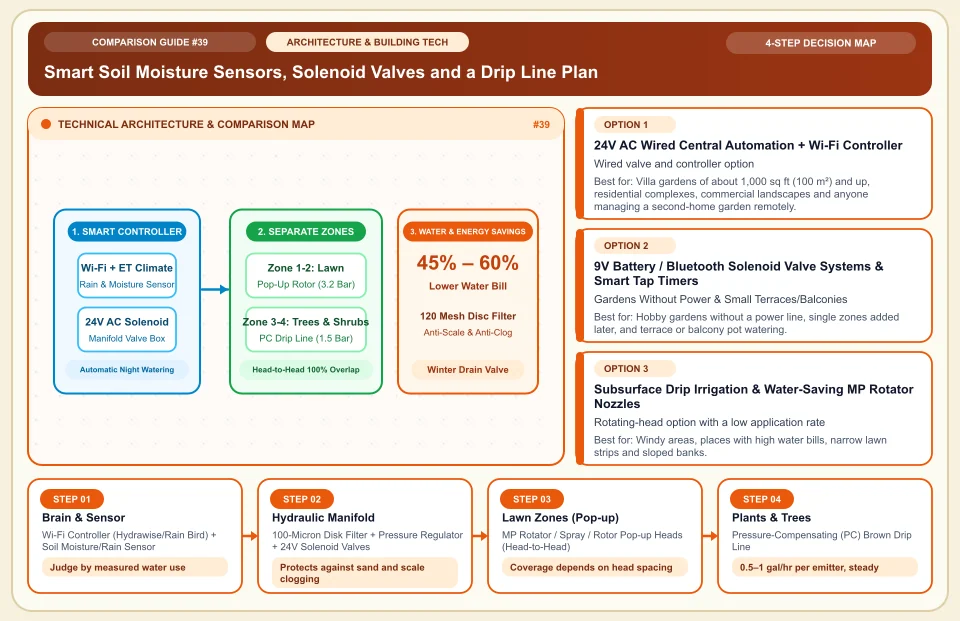
Weather / Soil Moisture Sensor → Wi-Fi Controller → Manifold Valve Box (24V Solenoid) → Lawn Pop-ups & PC Drip:
Wi-Fi Controller (Hydrawise/Rain Bird) + Soil Moisture/Rain Sensor
It checks a weather station and a buried moisture sensor; if rain is coming tomorrow or the soil is wet, it keeps the valve closed.
100-Micron Disk Filter + Pressure Regulator + 24V Solenoid Valves
Choose the filter based on how much sediment your water carries and the valve and head maker's technical requirements.
MP Rotator / Spray / Rotor Pop-up Heads (Head-to-Head)
Heads retract below the surface when watering ends, so the mower will not hit them; each head should throw water to the base of the next (head-to-head).
Pressure-Compensating (PC) Brown Drip Line
Even on a slope, the first tree and the last tree 150 ft (50 m) down the line get the same amount of water, dripped straight into the root zone.
An Honest Comparison of the Different Types, Pros and Cons
See the bottlenecks that marketing brochures hide, how each type works, and who each architecture suits, side by side:
1. 24V AC Wired Central Automation + Wi-Fi Controller (Hunter Hydrawise / X2, Rain Bird ESP-ME3 / TM2)
A smart control panel in the garage or utility room converts mains power to 24V AC, and a multi-conductor underground signal cable runs to the valve boxes in the garden; the whole garden is managed from a phone.
✅ Strengths (pros)
- You never change batteries in a muddy valve box; it can run for years with little upkeep.
- With a flow meter added, a burst pipe or broken head is detected as excess flow, and the system can close the main valve automatically and alert your phone.
⚠️ Weaknesses & limits (cons)
- It calls for an insulated underground signal cable between the control panel and valve boxes, ideally laid during landscaping before the lawn goes in.
- The initial setup can feel like too much for a very small terrace or hobby garden with 2–3 zones.
Villa gardens of about 1,000 sq ft (100 m²) and up, residential complexes, commercial landscapes and anyone managing a second-home garden remotely.
2. 9V Battery / Bluetooth Solenoid Valve Systems (Hunter Node-BT, Rain Bird WPX/ESP-9V) & Smart Tap Timers (Gardena, Eve Aqua)
For finished gardens where cabling is not possible, waterproof (IP68) controllers run on 9V alkaline batteries and sit directly in the valve box or screw onto the garden tap.
✅ Strengths (pros)
- Battery valve control can be added to some existing plumbing without running cable; setup time depends on the product.
- For potted-plant drip lines on balconies and terraces, tap-end timers (Gardena, or Zigbee/Thread valves) are very practical.
⚠️ Weaknesses & limits (cons)
- Battery change intervals depend on the product and how heavily it is used.
- Bluetooth models cannot be controlled remotely (from another city); you can only set them from your phone when you are next to the garden, unless you add a Wi-Fi bridge.
Hobby gardens without a power line, single zones added later, and terrace or balcony pot watering.
3. Subsurface Drip Irrigation (SDI) & Water-Saving MP Rotator Nozzles
Instead of misting spray nozzles, MP Rotator heads throw thick streams, or root-proof (copper-disc) drip line is buried about 4 in (10 cm) under the lawn.
✅ Strengths (pros)
- MP Rotator nozzles throw water slowly in thick drops, so it does not blow onto the neighbor's wall in wind or run off as mud on slopes.
- With subsurface drip (SDI) the lawn surface stays dry, so children can play on the grass even while it is being watered.
⚠️ Weaknesses & limits (cons)
- MP Rotator run times are 2–3 times longer than with standard spray heads (the same water, applied more slowly so it soaks in).
- Subsurface systems must always use a good filter and an air-release (vacuum relief) valve.
Windy areas, places with high water bills, narrow lawn strips and sloped banks.
Side-by-Side Technical Criteria and Performance Table
The core engineering, cost and usage parameters you can compare directly when deciding:
| Criterion | 24V AC Wired + Wi-Fi Controller | 9V Battery Valve Box (Node-BT) | Tap-End Battery Timer | Hand Watering with a Hose | Bottom Line |
|---|---|---|---|---|---|
| Remote control | Depends on controller and connection | Depends on a nearby connection | Depends on hub and connection | Manual | Test what happens when the connection drops. |
| Rain shutoff | Depends on sensor and settings | Depends on the sensor option | Depends on the sensor option | Manual decision | Confirm sensor and controller compatibility first. |
| Power and upkeep | Depends on mains power and upkeep | Depends on batteries and upkeep | Depends on batteries and upkeep | Depends on your labor | Do a start-of-season run check. |
| Leak detection | If a flow sensor is fitted | May need an extra sensor | May need an extra sensor | Manual observation | An alarm will not prevent every leak. |
| Scheduling | Programmable | Programmable | Programmable on some models | Set by hand | Set run times for your local plants and climate. |
Providers and reference points
Providers, platforms or official information sources you can weigh against your own needs. The list is not a market-share ranking or a physical product test.
Hunter Industries (Hydrawise, PGV Valves, PGP Rotor & MP Rotator)
- Hydrawise cloud software with predictive watering from local weather stations, sturdy PGV solenoid valves and MP Rotator nozzles make it a common first choice among landscape designers.
- Choose components (body, nozzle, valve, controller) through a professional irrigation supplier, against a project calculation.
Rain Bird (ESP-ME3 / TM2 + LNK2 Wi-Fi, DV/PGA Valves, 5004 Rotor & XF-SDI Drip)
- Its solenoid valves hold up well in dirty well water, and with copper-shielded (root-proof) subsurface drip line and 5004-series rotor heads it shares the top spot with Hunter.
- The mobile app is more traditional than Hunter Hydrawise.
Gardena (Smart System / Micro-Drip) & Netafim (Techline PC Drip)
- Gardena offers plug-and-play pot and lawn automation for terraces, balconies and small gardens without calling a pro; Israel-founded Netafim is a global reference for pressure-compensating (PC) drip tubing.
- Gardena's underground pipe and head system costs much more on large gardens than the industrial PE pipe from Hunter or Rain Bird.
Category 4: Architecture, Building & Living Spaces
In-room soundproofing, R290 heat pumps, reverse-osmosis water purifiers, hydroponic farming, ergonomics, solar low-E facades and smart irrigation.
Sources and review method
The EPA WaterSense source explains how soil moisture sensing limits unnecessary watering. Changes in water use should be measured against flow, plants, climate and system settings.
Sources checked:
- US EPA WaterSense — Soil Moisture-Based Irrigation Controllers ↗
Watering based on soil moisture; savings depend on design and settings.
Frequently Asked Questions
I use well water in my garden; why do the sprinkler heads and valves keep clogging?
If well or mains water carries sediment, find the filtration level the valve and emitter maker asks for; choose the filter type from a water analysis and the device data.
How do I keep pipes from freezing and bursting in an automatic irrigation system when winter comes?
In regions with hard freezes, shut the main water valve in autumn and blow the lines out with compressed air through the manifold blow-out port so the pipes and pop-up heads are fully drained. In mild climates, closing the main valve and opening the last valves once to release pressure is usually enough.
Why is "head-to-head" spacing the rule when watering a lawn?
Plan sprinkler spacing around the head's real throw pattern, pressure, wind and the manufacturer's chart; no single spacing rule suits every product.