
The physical difference between soundproofing that blocks noise from the neighbors (heavy barrier + mineral wool + acoustic drywall) and decorative acoustic panels that tame echo inside a room, with a build-up diagram.
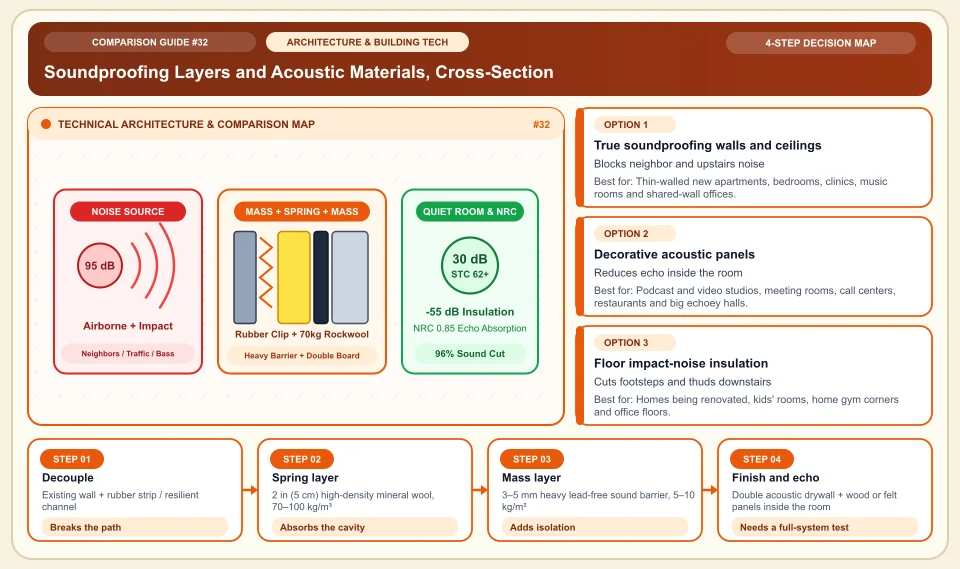
Egg-crate foam or decorative slatted felt panels on the wall will NOT block your neighbor's voices or TV. They only reduce echo inside your own room. To block neighbor noise you need a "mass + spring + mass" sandwich: heavy sound barrier, mineral wool and double drywall.
Sound absorption reduces echo inside a room; soundproofing limits the sound that passes into the next space. For decorative panels, ask for the absorption coefficient. For a wall or window, ask for the measured sound transmission performance of the whole system.
Thin absorbing foam can reduce echo, but transmission loss against neighbor noise depends on every layer of the wall and on how well it is sealed.
The decibel scale is logarithmic. Perceived change depends on frequency, starting level and test conditions. Do not trust fixed "percent quieter" claims without a source.
Impact noise (footsteps) should be designed by a specialist, based on the source floor, the ceiling hangers and the connection details.
Soundproofing Layers and Acoustic Materials, Cross-Section
A 3–4 in (8–10 cm) "mass-spring-mass" wall that stops neighbor noise, plus acoustic panels that absorb echo inside the room:
Existing wall + rubber strip / resilient channel
If metal studs are screwed straight into the masonry, sound passes right through. Use an EPDM rubber strip and vibration-damping mounts in between.
2 in (5 cm) high-density mineral wool, 70–100 kg/m³
Fiber friction turns sound energy in the gap between the two walls into heat, which kills cavity resonance.
3–5 mm heavy lead-free sound barrier, 5–10 kg/m²
Thin but heavy. It blocks low-frequency sound such as bass and deep voices from passing through.
Double acoustic drywall + wood or felt panels inside the room
Once outside noise is blocked, slatted or fabric panels on the inner surface bring down speech echo (RT60).
An Honest Comparison of the Different Types, Pros and Cons
See the bottlenecks that marketing brochures hide, how each type works, and who each architecture suits, side by side:
1. True soundproofing walls and ceilings (mineral wool + EPDM barrier + acoustic drywall)
An engineered wall built from layers that do not touch each other ("mass-spring-mass"), which costs you about 3–4 in (7–10 cm) of room.
✅ Strengths (pros)
- Brings loud conversation, TV, a crying baby or snoring from the next unit down to an inaudible level.
- The layers can also help with thermal and sound performance. Fire rating must be verified for the whole system.
⚠️ Weaknesses & limits (cons)
- Takes 3–4 in (8–10 cm) off the room width per wall, and 4–5 in (10–12 cm) of ceiling height.
- Needs drywall, compound and paint work, so it is a messy renovation of a day or two.
Thin-walled new apartments, bedrooms, clinics, music rooms and shared-wall offices.
2. Decorative acoustic panels (slatted felt, fabric-wrapped, acoustic foam)
Porous felt, glass wool or open-cell foam absorbs sound waves that bounce around the room (reverberation).
✅ Strengths (pros)
- The right material in the right spot can cut reflections. The result depends on room volume, surfaces and installation.
- Slatted wood panels go up in about an hour with mounting adhesive, no drilling, and give the space a modern look.
⚠️ Weaknesses & limits (cons)
- A decorative panel's effect on neighbor noise has to be judged against the whole wall system, and alone it is not isolation.
- Check the product's reaction-to-fire class on its datasheet. The fire performance of the whole wall needs a specialist.
Podcast and video studios, meeting rooms, call centers, restaurants and big echoey halls.
3. Floor impact-noise insulation (rubber sheet, cork underlay, floating screed)
A resilient rubber or cork layer under the flooring or screed keeps the vibration of footsteps from entering the building structure.
✅ Strengths (pros)
- How much impact noise drops depends on the source floor and a tested build-up.
- When replacing flooring, a 3–5 mm high-density cork-rubber sheet can replace the thin foam underlay.
⚠️ Weaknesses & limits (cons)
- Blocking your upstairs neighbor's footsteps from your own ceiling is much harder than laying an underlay under their floor, because vibration also travels down the columns.
- If laid very thick, door bottoms and thresholds may need trimming by a few millimeters.
Homes being renovated, kids' rooms, home gym corners and office floors.
Side-by-Side Technical Criteria and Performance Table
The core engineering, cost and usage parameters you can compare directly when deciding:
| Criteria | Heavy-barrier drywall wall (3–4 in) | Mineral wool + drywall (2.5–3 in) | Slatted felt acoustic panel (¾ in) | Egg-crate / pyramid foam | Engineering call |
|---|---|---|---|---|---|
| Neighbor noise transmission | Depends on the tested wall detail | Depends on the tested wall detail | Not isolation on its own | Not isolation on its own | Ask for measured transmission loss for the whole system. |
| Echo inside the room | Depends on the surface finish | Depends on the surface finish | Depends on absorption tests | Depends on absorption tests | Echo and neighbor noise are separate problems. |
| Lost space | Depends on the project section | Depends on the project section | Depends on panel thickness | Depends on panel thickness | Check on-site measurements and fire details together. |
| Fire performance | Depends on the whole system class | Depends on the whole system class | Depends on product and install | Depends on product and install | One material label does not define the whole wall. |
| Installation | Needs a specialist | Needs a specialist | Follow the maker's instructions | Follow the maker's instructions | Check the measurements and the sealing details. |
Providers and reference points
Providers, platforms or official information sources you can weigh against your own needs. The list is not a market-share ranking or a physical product test.
Knauf (Silentboard / Diamant acoustic drywall) & Saint-Gobain Rigips (Habito / Soundroc)
- Judge the total sound-insulation contribution of acoustic board and hangers through the maker's tested system details.
- Even with the right material, if the installer skips the rubber strip under the profile or leaves outlet cut-outs open, sound leaks through the gap.
Rockwool & Knauf Insulation (mineral wool) and Tecsound (heavy EPDM sound barriers)
- The heavy barrier and cavity fill are judged by the tested wall section, together with the rest of the build-up.
- They are never left exposed. They always sit inside the drywall sandwich.
Category 4: Architecture, Building & Living Spaces
In-room soundproofing, R290 heat pumps, reverse-osmosis water purifiers, hydroponic farming, ergonomics, solar low-E facades and smart irrigation.
Sources and review method
Uses the CDC/NIOSH distinction between sound absorption and blocking sound transmission. For a specific decibel result, you need a tested full wall or window system.
Sources checked:
- CDC/NIOSH — Implement Engineering Controls ↗
The different jobs of absorbing sound and blocking its transmission.
Frequently Asked Questions
If I put a flush electrical outlet in my new soundproof wall, will sound leak through?
Yes, and it is the most common installer mistake. Wherever water can seep, sound can too. A recessed outlet box punches a hole in the barrier, and your neighbor's noise comes right through it. On a soundproofed wall, either avoid outlets or use surface-mounted ones (or a dedicated acoustic outlet box).
How do I block street and traffic noise from the window?
Window sound performance depends on glass thickness plus the frame, seals, installation and air leakage. Ask the maker for the lab-tested sound insulation rating of the whole window system.
If I put mineral wool behind slatted acoustic panels, will it reduce neighbor noise at all?
Slatted absorbing panels can reduce echo in the room. For neighbor noise, you need a transmission test of the whole wall system. A single decibel figure does not apply to every wall.