
Grid-tied, off-grid and hybrid rooftop solar systems, plus TOPCon monocrystalline panels, string vs micro inverters and LFP batteries.
If you want backup power during outages, the inverter’s backup output, the battery and the critical-load circuit must be designed in from the start.
A standard grid-tied solar system shuts down during an outage in most installations, for safety. Backup power needs a suitable inverter, an isolation setup, battery capacity and an engineered critical-load list. Zero bills or uninterrupted power depend on the installation.
If you have shading, compare string, optimizer and microinverter options using the roof plan and a production simulation.
Compare battery chemistries on cycle life, temperature, fire safety, warranty and installation conditions; do not treat any chemistry as fireproof or fixed-life.
Ask a professional to judge net metering or self-consumption against your current utility connection rules and your real usage profile.
Rooftop Solar Components
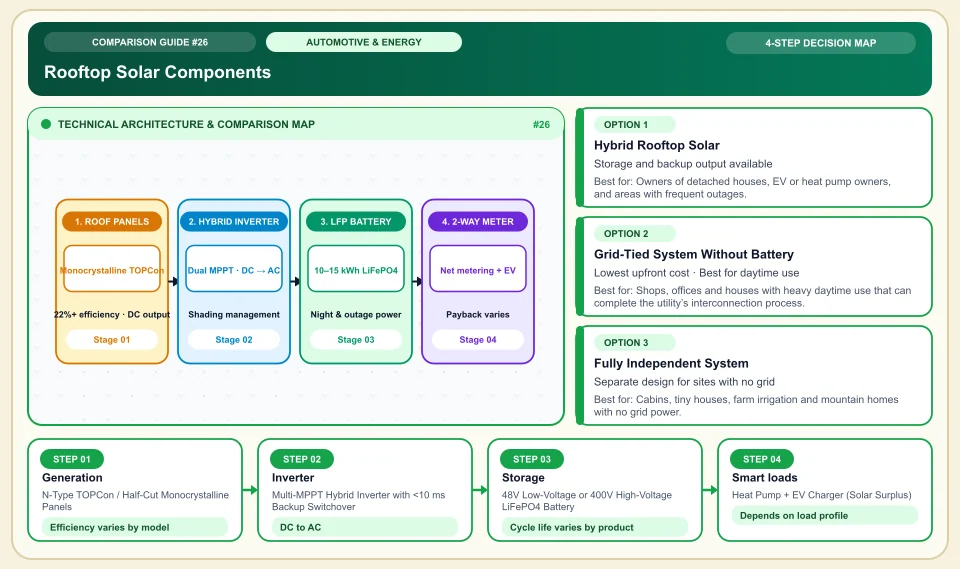
From sunlight to DC power, through the hybrid inverter to LFP storage and the home AC panel:
N-Type TOPCon / Half-Cut Monocrystalline Panels
Compared with older polycrystalline panels, they tend to lose less output in low morning and evening light and in summer heat.
Multi-MPPT Hybrid Inverter with <10 ms Backup Switchover
It serves the home’s live demand first and charges the battery with the surplus; when the grid drops, it feeds the critical-load panel from the battery within milliseconds.
48V Low-Voltage or 400V High-Voltage LiFePO4 Battery
Using daytime solar in the evening depends on battery capacity, your loads and your tariff.
Heat Pump + EV Charger (Solar Surplus)
Once the battery is full, spare solar is not wasted; it can be sent to an electric car or a water heater automatically.
An Honest Comparison of the Different Types, Pros and Cons
See the bottlenecks that marketing brochures hide, how each type works, and who each architecture suits, side by side:
1. Hybrid Rooftop Solar (Panels + Hybrid Inverter + LFP Battery — Self-Consumption Focus)
In hybrid systems that work with both the grid and a battery, backup power is designed with suitable isolation hardware and a separate critical-load circuit.
✅ Strengths (pros)
- With a self-consumption or zero-export setup, it can be commissioned quickly without waiting on export approvals from the utility.
- During an outage it can supply supported loads up to the battery capacity and the inverter’s instant power.
⚠️ Weaknesses & limits (cons)
- Compare the battery’s extra cost on the same quote and the same capacity.
- How long which loads stay powered in a long outage depends on battery size and solar production.
Owners of detached houses, EV or heat pump owners, and areas with frequent outages.
2. Grid-Tied System Without Battery (On-Grid + Net Metering or Export Credit)
No battery. Surplus daytime power goes to the grid through a bidirectional meter, and what you draw at night is offset where your utility offers net metering or export credits.
✅ Strengths (pros)
- With no battery cost, it usually has the shortest payback.
- If air conditioning, a pool pump or a business load runs in the daytime, you use the power the moment it is made and cut your bill.
⚠️ Weaknesses & limits (cons)
- Standard grid-tied PV shuts off during an outage unless a backup output was designed in.
- Utility interconnection approval and inspection take engineering follow-up and time, and the rules differ by utility and region.
Shops, offices and houses with heavy daytime use that can complete the utility’s interconnection process.
3. Fully Independent System (Off-Grid — Cabins, Tiny Houses, Remote Land)
For land with no grid line, it combines solar panels, an MPPT charge controller or inverter, a large LFP battery bank and a backup generator for winter.
✅ Strengths (pros)
- It can power remote land in a day when running a grid line would mean very high transformer and pole costs.
- There is no electricity bill or fixed subscription fee.
⚠️ Weaknesses & limits (cons)
- If the sun does not come out for four days in a row in midwinter, the battery runs flat; if that will happen regularly, keep a small auto-start gasoline or LPG generator as backup.
- Heavy loads that draw power at once, like resistance water heaters, ovens and irons, must be used with care against the battery capacity.
Cabins, tiny houses, farm irrigation and mountain homes with no grid power.
Side-by-Side Technical Criteria and Performance Table
The core engineering, cost and usage parameters you can compare directly when deciding:
| Criterion | Hybrid (Panels + LFP) | On-Grid (No Battery) | Off-Grid | Takeaway |
|---|---|---|---|---|
| Power during outage | Depends on backup circuit design | Shuts down on standard grid connection | Depends on battery and load | Needs an isolation and critical-load design. |
| Night use | Depends on battery and production profile | Depends on grid and net metering | Depends on battery capacity | Compare hourly usage and your tariff. |
| Upfront cost | Get a quote that includes the battery | Get a quote without a battery | Needs an off-grid capacity calculation | Get quotes for the same panel and load scope. |
| Shading | Depends on string and module design | Depends on MPPT and string design | Depends on layout design | Ask for a roof plan and production simulation. |
| Warranty and upkeep | Depends on product and installation | Depends on product and installation | Depends on product and installation | Read panel, inverter and battery terms separately. |
Providers and reference points
Providers, platforms or official information sources you can weigh against your own needs. The list is not a market-share ranking or a physical product test.
Fronius, SMA, Huawei FusionSolar & SolarEdge
- Huawei has the modular LUNA2000 LFP battery and panel-level optimizers; Fronius (GEN24 Plus) and SMA are known for European build, long life and high efficiency.
- Huawei and SolarEdge work with high-voltage batteries inside their own ecosystems; you cannot attach a cheaper third-party 48V battery.
Deye, Victron Energy & GoodWe / Growatt
- Victron is a leader in marine and off-grid work; Deye hybrid inverters are value leaders thanks to grid and generator inputs and open compatibility with 48V LFP batteries such as Pylontech and Dyness.
- Victron components (MPPT, Cerbo GX, MultiPlus) must be assembled in a panel by an experienced installer.
Category 3: Automotive, Mobility & Energy Technologies
Hybrid powertrain architectures, home solar systems, winter tire tests, ECE 22.06 helmets and LFP/NMC battery chemistries.
Sources and review method
The DOE article explains how a standard grid-tied PV system behaves in an outage. Backup power and battery size should be engineered around the home’s load profile.
Sources checked:
- U.S. DOE — The Road to Resilience with Rooftop Solar ↗
How standard grid-tied PV differs from PV with storage during a grid outage.
Frequently Asked Questions
How many kW of panels and how many kWh of battery do I need?
Sizing needs your annual and hourly electricity use, roof orientation and shading, local sunlight and any backup load. There is no universal panel or battery size.
Will installing panels crack my roof tiles or make the roof leak?
Roof anchoring, waterproofing, wind load and electrical safety should follow a design that fits the roof type. Ask for the manufacturer-approved mounting detail and an installation warranty in writing.
Can hail break solar panels?
Hail and wind resistance depend on the panel’s test certificate and your insurance coverage. Nobody can guarantee there will be no damage or that insurance will pay in a specific event.