
How mild hybrid (MHEV), full hybrid (HEV) and plug-in hybrid (PHEV) SUVs work, and how fuel use is measured.
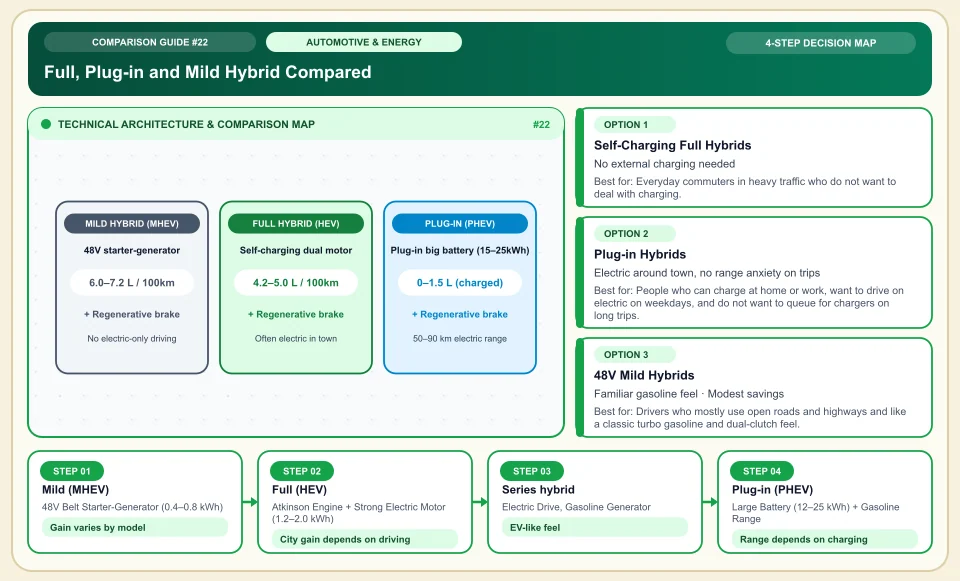
When comparing hybrid SUVs, keep MHEV, HEV and PHEV apart, and compare savings on the same model year under similar driving conditions.
Mild, full and plug-in hybrids work in different ways. Fuel use and electric range depend on the model, battery charge, temperature, route and driving style, so a single advertised saving is not a real-world result.
Before buying, confirm whether the car is an MHEV, HEV or PHEV and which official test cycle its consumption figure uses.
Look at HEV consumption for city and highway driving separately; the electric contribution depends on how you drive.
A PHEV pays off only with regular charging and a typical daily route; check whether you can charge at home or work.
Full, Plug-in and Mild Hybrid Compared
Battery size, electric motor role and regenerative braking in three hybrid designs:
48V Belt Starter-Generator (0.4–0.8 kWh)
It cannot drive the wheels on its own (at most it helps in parking moves); its main job is smoothing the start-stop restart.
Atkinson Engine + Strong Electric Motor (1.2–2.0 kWh)
No plug. The battery refills on every brake and downhill stretch, and low-speed starts and cruising can run silently on electric power.
Electric Drive, Gasoline Generator
In town the gasoline engine never drives the wheels; it only makes electricity, for smooth, instant torque.
Large Battery (12–25 kWh) + Gasoline Range
Plug in overnight and commute on electric power; take long trips on gasoline without hunting for a charger.
An Honest Comparison of the Different Types, Pros and Cons
See the bottlenecks that marketing brochures hide, how each type works, and who each architecture suits, side by side:
1. Self-Charging Full Hybrids (HEV — Toyota, Honda, Renault E-Tech, Nissan)
Never plugged in; it stores braking energy that would otherwise be lost as heat and shuts the gasoline engine off in stop-and-go traffic.
✅ Strengths (pros)
- Works without any charger, though city consumption should still be compared within the same class.
- Regenerative braking can reduce use of the mechanical brakes; part life depends on the car and how it is used.
⚠️ Weaknesses & limits (cons)
- In planetary-gear (e-CVT) models, flooring the pedal on a steep hill or a hard overtake can make the engine rev high and drone.
- Electric-only driving ability depends on the model and its battery management.
Everyday commuters in heavy traffic who do not want to deal with charging.
2. Plug-in Hybrids (PHEV — BYD, Volvo, BMW, Peugeot, Jaecoo)
Combines a large battery (15–26 kWh) charged from a cable with a full-size gasoline tank.
✅ Strengths (pros)
- A PHEV charged regularly can cover short trips on electricity; real range depends on the model and conditions.
- Where purchase incentives or tax rules favor longer-range PHEVs, the price-to-equipment ratio can be very good; check what applies where you live.
⚠️ Weaknesses & limits (cons)
- If you will not plug in regularly, a PHEV makes little sense; an empty battery’s extra weight can push fuel use above a full hybrid’s.
- With both a gasoline engine to service and a large battery and charging system, it is mechanically the most complex.
People who can charge at home or work, want to drive on electric on weekdays, and do not want to queue for chargers on long trips.
3. 48V Mild Hybrids (MHEV — Volkswagen eTSI, Ford EcoBoost mHEV and other mild-hybrid SUVs)
A small 48V lithium battery and a belt starter-generator are added to an ordinary turbo gasoline engine.
✅ Strengths (pros)
- Makes the engine stop and restart at a red light almost unnoticeable and very smooth.
- Adds less cost than a full hybrid and does not eat into trunk space.
⚠️ Weaknesses & limits (cons)
- Compare MHEV and HEV fuel use using official and real-world data for models in the same class.
- Buying one assuming it is a full hybrid just because it says "Hybrid" is the most common disappointment.
Drivers who mostly use open roads and highways and like a classic turbo gasoline and dual-clutch feel.
Side-by-Side Technical Criteria and Performance Table
The core engineering, cost and usage parameters you can compare directly when deciding:
| Criterion | Full Hybrid (HEV) | Plug-in Hybrid (PHEV) | 48V Mild Hybrid (MHEV) | Takeaway |
|---|---|---|---|---|
| City fuel use | Depends on model and driving | Depends on charging habits | Depends on model and driving | Compare the same model class and test cycle. |
| External charging | No plug needed | Regular charging needed for the benefit | No plug needed | Weigh a PHEV together with your charging access. |
| Electric driving | Short electric assists | Depends on the model’s electric range | Depends on the MHEV design | Real range varies with temperature and route. |
| Highway fuel use | Depends on engine and speed | Depends on charge state and speed | Depends on engine and speed | Read highway data from the same test conditions. |
| Battery and service | Depends on manufacturer warranty | Depends on manufacturer warranty | Depends on manufacturer warranty | Confirm the model year and service coverage. |
Providers and reference points
Providers, platforms or official information sources you can weigh against your own needs. The list is not a market-share ranking or a physical product test.
Toyota (Yaris Cross, Corolla Cross, C-HR, RAV4 — Hybrid)
- Check Toyota’s consumption figures and hybrid battery warranty terms for your model year in the maker’s official documents.
- Engine noise can reach the cabin under hard acceleration, and interior multimedia and insulation feel plainer than European rivals.
Renault E-Tech Full Hybrid (Austral, Symbioz, Captur, Rafale) & Dacia Jogger/Duster Hybrid
- Compare Renault E-Tech output and consumption by trim, model year and test cycle.
- The multi-mode dog-clutch gearbox can feel like a brief gear change between speeds, unlike Toyota’s e-CVT.
Honda (HR-V e:HEV, ZR-V e:HEV, CR-V e:HEV) & Nissan (Qashqai / X-Trail e-Power)
- An electric motor drives the wheels directly, so throttle response and quietness come closest to a full EV among full hybrids.
- At highway speeds (130+ km/h), Nissan e-Power’s generator engine runs at constant high revs and can use a bit more fuel than Toyota or Renault.
BYD (Seal U DM-i) & Volvo / Peugeot / BMW (long-range PHEV SUVs)
- BYD DM-i electric and total range vary by model year, battery and test cycle.
- Keeping the advantage takes a regular charging habit.
Category 3: Automotive, Mobility & Energy Technologies
Hybrid powertrain architectures, home solar systems, winter tire tests, ECE 22.06 helmets and LFP/NMC battery chemistries.
Sources and review method
DOE AFDC explains that a plug-in hybrid’s fuel use depends on how often it is charged and how far it is driven. Compare model consumption and range on the same test cycle.
Sources checked:
- DOE AFDC — Plug-In Hybrid Electric Vehicles ↗
How charging frequency and driving distance affect PHEV fuel use.
Frequently Asked Questions
If a full hybrid’s battery dies, will I be stranded, and how often does it need replacing?
Battery management differs by model. No universal mileage or year figure can be promised for battery life, so read the maker’s warranty and service terms.
Is there a risk the "CVT belt will snap" in a full hybrid?
The names are confusing. A conventional CVT has a steel belt and pulleys, but the "e-CVT" in Toyota and Ford full hybrids has no belt, chain or clutch plates. It uses two electric motors and a planetary gear set, one of the least wear-prone mechanisms around.
How should I drive a hybrid to use less fuel (what is "pulse and glide")?
Follow the manufacturer’s driving tips and watch the real-time consumption display. One pedal technique does not give the same result in every hybrid.