
Premium makers that win ADAC and AutoBild winter tire tests (Continental, Michelin, Goodyear, Bridgestone, Nokian), the 3PMSF mark, and winter vs all-season tires.
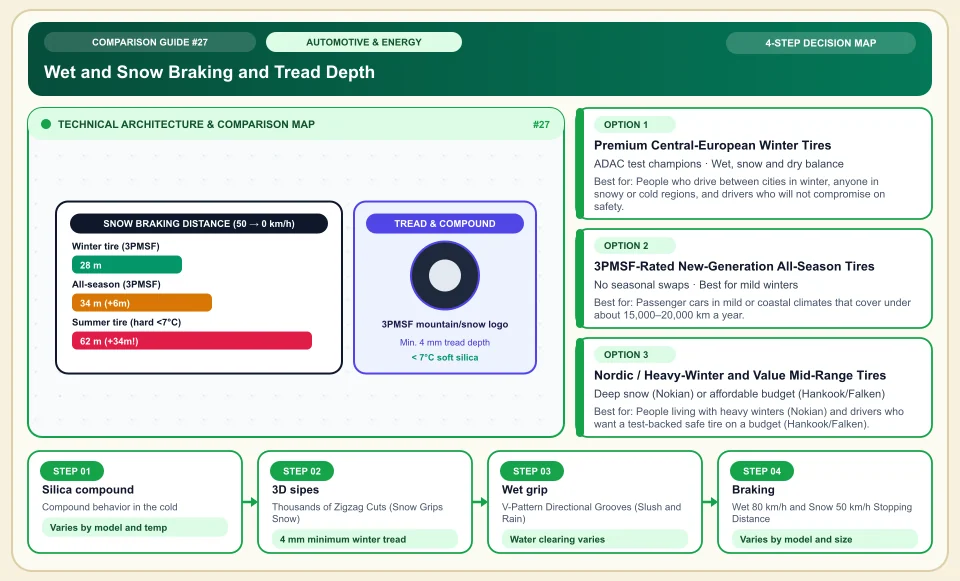
No single brand wins winter tire tests every year; year, size and test surface change the result.
Winter tire results are specific to the test year, size, model and the wet, dry, snow or ice condition. In the 2026 ADAC results, the 185/65 R15 and 225/50 R17 sizes were rated separately; do not carry one ranking over to a model in another size.
Read the latest test for your own size and load index, and look at wet, dry and snow results together.
An "M+S" marking does not prove a true winter tire; look for the Three-Peak Mountain Snowflake (3PMSF) symbol on the sidewall.
Do not wait until the legal 1.6 mm limit; a winter tire’s sipes lose their snow-gripping effect below about 4 mm of tread.
Wet and Snow Braking and Tread Depth
Comparing winter tires on wet, dry, snow and ice in the same size and test year:
Compound behavior in the cold
A summer tire goes rock hard in the cold and cannot grip the asphalt, while a winter compound stays flexible.
Thousands of Zigzag Cuts (Snow Grips Snow)
Sipes open as the tire rolls and fill with snow; snow on snow grips far better than rubber on snow.
V-Pattern Directional Grooves (Slush and Rain)
They push slush and rain out from under the tread quickly to help prevent aquaplaning.
Wet 80 km/h and Snow 50 km/h Stopping Distance
ADAC braking results vary by model and size; quote a specific distance or speed only with the matching test report.
An Honest Comparison of the Different Types, Pros and Cons
See the bottlenecks that marketing brochures hide, how each type works, and who each architecture suits, side by side:
1. Premium Central-European Winter Tires (Continental WinterContact, Michelin Alpin, Goodyear UltraGrip, Bridgestone Blizzak)
Designed to give the shortest braking and the longest mileage both in heavy snow and on cold, rainy highways all winter.
✅ Strengths (pros)
- In ADAC and AutoBild blind braking tests of dozens of tires, they regularly share the top five on both wet roads and snow.
- Compare tire mileage only at the same size and test conditions; driving style and storage change the result.
⚠️ Weaknesses & limits (cons)
- Compare the price gap using current dealer quotes for the same size.
- If not swapped off in summer (above +15°C), the soft compound wears quickly and raises fuel use.
People who drive between cities in winter, anyone in snowy or cold regions, and drivers who will not compromise on safety.
2. 3PMSF-Rated New-Generation All-Season Tires (Michelin CrossClimate 2/3, Continental AllSeasonContact 2, Goodyear Vector 4Seasons Gen-3)
Combines a summer tire’s shoulder stability with a winter tire’s V-pattern sipes and a hybrid compound that works over a wide temperature range.
✅ Strengths (pros)
- Removes the twice-a-year tire shop queue, the swap and balance fee and the tire-storage cost.
- The 3PMSF mark shows the product passed the relevant snow test; also check local requirements and real road conditions.
⚠️ Weaknesses & limits (cons)
- Compare ice performance in same-size tests of the chosen all-season and winter models.
- Judge summer performance in the product’s latest independent test.
Passenger cars in mild or coastal climates that cover under about 15,000–20,000 km a year.
3. Nordic / Heavy-Winter and Value Mid-Range Tires (Nokian, Hankook, Falken)
Northern specialists such as Nokian give maximum grip on ice and deep snow, while Hankook and Falken offer a safe winter compound at an attainable price.
✅ Strengths (pros)
- The Hankook Winter i*cept (RS3 / evo3) line has often come closest to the premium brands in European tests for value.
- The Nokian Hakkapeliitta / Snowproof lines give outstanding traction on heavy snow, ice and mountain roads.
⚠️ Weaknesses & limits (cons)
- Very soft Nordic compounds can wear faster on warm, dry asphalt.
- Wet braking distance and rolling noise (dB) on budget lines can sit a step behind the premium rivals.
People living with heavy winters (Nokian) and drivers who want a test-backed safe tire on a budget (Hankook/Falken).
Side-by-Side Technical Criteria and Performance Table
The core engineering, cost and usage parameters you can compare directly when deciding:
| Criterion | Premium Winter (Conti / Michelin / GY) | Premium All-Season (CrossClimate 2 etc.) | Value Mid-Range Winter (Hankook) | Budget Winter Tires | Takeaway |
|---|---|---|---|---|---|
| Wet braking | Depends on size and test year | Depends on size and test year | Depends on size and test year | Depends on size and test year | Read the latest independent test in your size. |
| Snow traction | Depends on size and test year | Depends on size and test year | Depends on size and test year | Depends on size and test year | Check the test surface and load index. |
| Wear | Depends on model test | Depends on model test | Depends on model test | Depends on model test | Do not treat estimated mileage as warranted life. |
| Seasonal swaps | Seasonal swap may be needed | Depends on your climate | Seasonal swap may be needed | Seasonal swap may be needed | Check local rules and your real climate. |
| EV suitability | Load index depends on model | Load index depends on model | Load index depends on model | Load index depends on model | Follow the carmaker’s size and load requirement. |
Providers and reference points
Providers, platforms or official information sources you can weigh against your own needs. The list is not a market-share ranking or a physical product test.
Continental (WinterContact TS 870 / TS 870 P & AllSeasonContact 2)
- The TS 870 line has sat at the top of European tests for years for its balance of cold wet braking, slush resistance and low fuel use.
- Its unit price is in the top bracket of the market.
Michelin (Alpin 6 / Pilot Alpin 5 & CrossClimate 2 / 3)
- EverGrip technology opens new grooves as the tire wears, so it keeps snow grip even as tread falls (to about 4 mm) and gives the longest mileage.
- It has the highest purchase price of the brands here.
Goodyear (UltraGrip Performance 3) & Bridgestone (Blizzak LM005 / Blizzak 6)
- The Bridgestone Blizzak line has set wet-braking records, while the Goodyear UltraGrip Performance 3 shares test wins on quietness and snow/wet balance.
- The Blizzak LM005’s soft, high-grip compound can wear a bit faster than Michelin if left on in warm weather (the newer Blizzak 6 Enliten extends its life).
Hankook (Winter i*cept RS3 / evo3) & Nokian (Snowproof)
- Compare Hankook and Nokian models only on independent results in the same size and test year.
- Budget lines can have somewhat higher rolling noise and fuel use than the premium European trio.
Category 3: Automotive, Mobility & Energy Technologies
Hybrid powertrain architectures, home solar systems, winter tire tests, ECE 22.06 helmets and LFP/NMC battery chemistries.
Sources and review method
The ADAC 2026 winter test rates two different tire sizes separately. Read the ranking only for the tested model, size and conditions.
Sources checked:
- ADAC — Winter Tire Test 2026 ↗
The 2026 test covers two tire sizes with model-specific results (in German).
Frequently Asked Questions
Is it enough to fit winter tires on just the two driven front wheels?
Matching tires on all four wheels matter for stability. Follow the vehicle manufacturer’s advice on size, load index and how to swap them.
How old can a tire be, going by the "DOT" date code, before I should not buy it?
The DOT code shows the production week and year. A tire’s condition cannot be judged by age alone; check storage, use, tread depth and damage together. ADAC advises not using winter tires older than eight years and replacing them below four millimeters.
Can I fit normal winter tires on my electric car?
For an EV, check that the tire matches the size and load index the carmaker specifies; an XL or HL marking is not required on every car.