
Thermoplastic vs composite/carbon helmet shells, the newer ECE 22.06 (rotational impact) standard, CE EN 17092 AAA jackets and D3O/Level 2 armor.
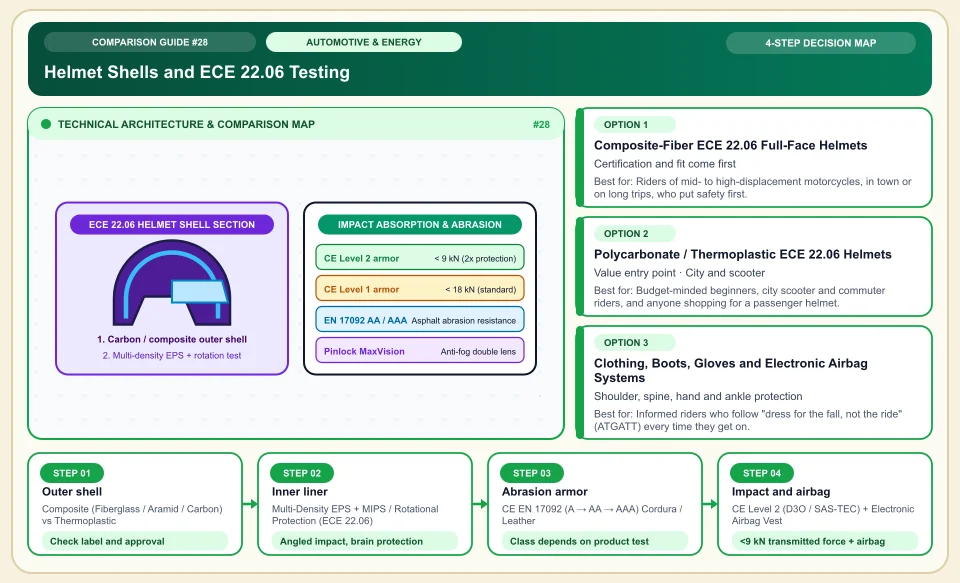
The outer shell helps prevent skull fracture, but what helps against concussion is the multi-density EPS foam inside and the angled and rotational impact management that ECE 22.06 requires.
For helmets and protective clothing, check the standard that applies where you ride, the model’s label, its intended use and the fit separately. No certificate guarantees you will not be hurt in a crash, and a product made to an older standard is not automatically useless.
Confirm the helmet’s approval label for where you ride, its maker and model details, and that it fits your head.
The certification, the fit and the maker’s replacement guidance matter as much as the shell material.
If a jacket has back armor, check the standard marked on it, its protection level and how well it fits the jacket.
Helmet Shells and ECE 22.06 Testing
From the outer shell fibers to the multi-density EPS layer, anti-fog visors and CE Level 2 impact absorption:
Composite (Fiberglass / Aramid / Carbon) vs Thermoplastic
The shell and the inner energy-absorbing layer work together; shell weight or material is no guarantee against neck strain.
Multi-Density EPS + MIPS / Rotational Protection (ECE 22.06)
EPS layers of different hardness absorb G-forces in both low- and high-speed impacts; emergency cheek pads (EQRS) let the helmet come off without straining the neck.
CE EN 17092 (A → AA → AAA) Cordura / Leather
Check the standard and abrasion class on the product label for protective clothing.
CE Level 2 (D3O / SAS-TEC) + Electronic Airbag Vest
Level 2 armor absorbs about twice the impact of Level 1; a wearable airbag vest inflates about 45 ms before the impact to lock the chest and spine.
An Honest Comparison of the Different Types, Pros and Cons
See the bottlenecks that marketing brochures hide, how each type works, and who each architecture suits, side by side:
1. Composite-Fiber (Fiberglass + Aramid + Carbon) ECE 22.06 Full-Face Helmets (Shoei, Arai, AGV, HJC RPHA, Schuberth)
Layers of glass fiber, organic fiber and carbon fiber, hand-laid or pressed in multiple layers, spread impact energy across the shell instead of concentrating it in one spot.
✅ Strengths (pros)
- Shell size, weight and aerodynamics vary by model, so check them by trying the helmet on.
- A helmet’s service life depends on the maker’s instructions, impacts, care and storage.
⚠️ Weaknesses & limits (cons)
- The labor-intensive process makes them two to four times the price of entry-level thermoplastic helmets.
- Judge the shell material and layer design by the product’s certification tests.
Riders of mid- to high-displacement motorcycles, in town or on long trips, who put safety first.
2. Polycarbonate / Thermoplastic ECE 22.06 Helmets (Nolan, LS2, MT, Caberg, HJC C/i Series, Scorpion)
A Lexan/polycarbonate outer shell made by high-pressure injection molding, with an ECE 22.06-approved EPS foam liner.
✅ Strengths (pros)
- Polycarbonate helmets that pass ECE 22.06 meet the legal and safe lower limit of impact protection on a reasonable budget.
- Higher-grade thermoplastics, like the Lexan polycarbonate Nolan uses, are far tougher than standard ABS plastic.
⚠️ Weaknesses & limits (cons)
- Weight and noise depend on the model and fit, not just the shell material.
- Set the replacement interval by the maker’s use and post-impact instructions, not by a generalization about the material.
Budget-minded beginners, city scooter and commuter riders, and anyone shopping for a passenger helmet.
3. Clothing, Boots, Gloves and Electronic Airbag Systems (Dainese, Alpinestars, Revit, Held)
Abrasion-resistant outer fabric or leather (EN 17092 AA/AAA), smart molecule armor that stiffens on impact (D3O / Nucleon Level 2), and gyro-based airbag vests.
✅ Strengths (pros)
- Hands and ankles are the first body parts to touch the ground; gloves with hard palm sliders help prevent scaphoid (wrist) fractures, and twist-resistant boots help prevent crushed feet.
- Electronic airbag vests can add a layer of protection; the level depends on the model and test conditions.
⚠️ Weaknesses & limits (cons)
- Full protective gear can be hot in summer (the fix is a mesh summer jacket with Level 2 back and shoulder armor plus Kevlar jeans, not riding in a T-shirt).
- Budget the full set using the current prices of the products you choose.
Informed riders who follow "dress for the fall, not the ride" (ATGATT) every time they get on.
Side-by-Side Technical Criteria and Performance Table
The core engineering, cost and usage parameters you can compare directly when deciding:
| Criterion | Composite / Fiberglass / Carbon (ECE 22.06) | Polycarbonate / Thermoplastic (ECE 22.06) | Flip-Up (Modular — P/J Approved) | Open-Face (Jet / Half) | Takeaway |
|---|---|---|---|---|---|
| Chin and face protection | Depends on full-face design | Depends on full-face design | Depends on latch and approval | No chin protection | Check the approval label and fit. |
| Weight and neck comfort | Depends on model and size | Depends on model and size | Depends on mechanism and size | Depends on model and size | Do not choose by grams without trying it on. |
| Impact performance | Depends on certification test | Depends on certification test | Depends on certification test | Depends on certification test | Shell material alone does not show the result. |
| Wind noise | Depends on model and visor | Depends on model and visor | Depends on model and visor | Depends on model and visor | Consider hearing protection on long rides. |
| Replacement and care | Depends on maker instructions | Depends on maker instructions | Depends on maker instructions | Depends on maker instructions | Follow the maker’s guidance after any impact or damage. |
Providers and reference points
Providers, platforms or official information sources you can weigh against your own needs. The list is not a market-share ranking or a physical product test.
Shoei (NXR2, GT-Air 3, Neotec 3) & Arai (Quantic, RX-7V Evo) & Schuberth
- Arai’s round, smooth R75 shell stands for the glancing-off philosophy, while Shoei stands for the multi-layer AIM+ composite shell, excellent ventilation and quiet.
- They sit in the top price bracket, and should not be ordered online without trying, since head shapes (round vs long oval) differ.
HJC (RPHA 12 / RPHA 71 / F71), AGV (K6 S / Tourmodular) & Scorpion (EXO-R1 / 1400 Evo II)
- At about half the price of Shoei or Arai, they offer real fiberglass or carbon-aramid (PIM Evo / Ultra-TCT) composite shells, a Pinlock 120 anti-fog lens in the box and ECE 22.06 protection.
- Liner lifespan and wind isolation above 140 km/h can sit half a step behind the Japanese pair.
Nolan (Lexan Series), Caberg, LS2 (Vector II Carbon / Storm II) & MT Helmets
- For Nolan, LS2 and MT, check the certification, model year, fit and features separately.
- On entry-level models, the outer shell can look a little rough and wind noise starts earlier.
Rev’it!, Dainese, Alpinestars, Held & Knox (Gear & Armor)
- Rev’it! is a reference for four-season and summer mesh design, Dainese and Alpinestars for leather/track gear and electronic airbag technology, and Held and Knox for gloves with palm sliders (scaphoid protection).
- Fake or replica copies of popular models circulate online, so buy only from authorized dealers.
Category 3: Automotive, Mobility & Energy Technologies
Hybrid powertrain architectures, home solar systems, winter tire tests, ECE 22.06 helmets and LFP/NMC battery chemistries.
Sources and review method
We use the NHTSA helmet guide’s criteria on compliance labels and fit. It describes the US standard and does not replace the rules where you ride (for example ECE 22.06 in Europe); protection depends on the product model and the crash.
Sources checked:
- NHTSA — Choose the Right Motorcycle Helmet ↗
Helmet standards, compliance labels and the limits of product safety.
Frequently Asked Questions
Is a flip-up (modular) helmet safe, and what should I watch for?
On a flip-up helmet, check the product’s approval label and the maker’s instructions for the chin section. Material or latch type alone is not a guarantee of crash safety.
Does an internal sun visor, or an intercom or camera mounted outside the helmet, make it less safe?
A certificate and material do not by themselves guarantee safety in a crash at a given speed. Try the helmet for your use and size, and follow the maker’s care and replacement instructions.
How big is the difference between Level 1 and Level 2 armor in a protective jacket?
Check the relevant product standard in the EN 1621 series and the level on the insert’s label. Passing laboratory values does not guarantee any individual injury outcome in a real crash.