
Energy density (Wh/kg), fire safety, cycle life and cold-weather behavior of LFP (LiFePO4), NMC, sodium-ion (Na-ion) and solid-state batteries.
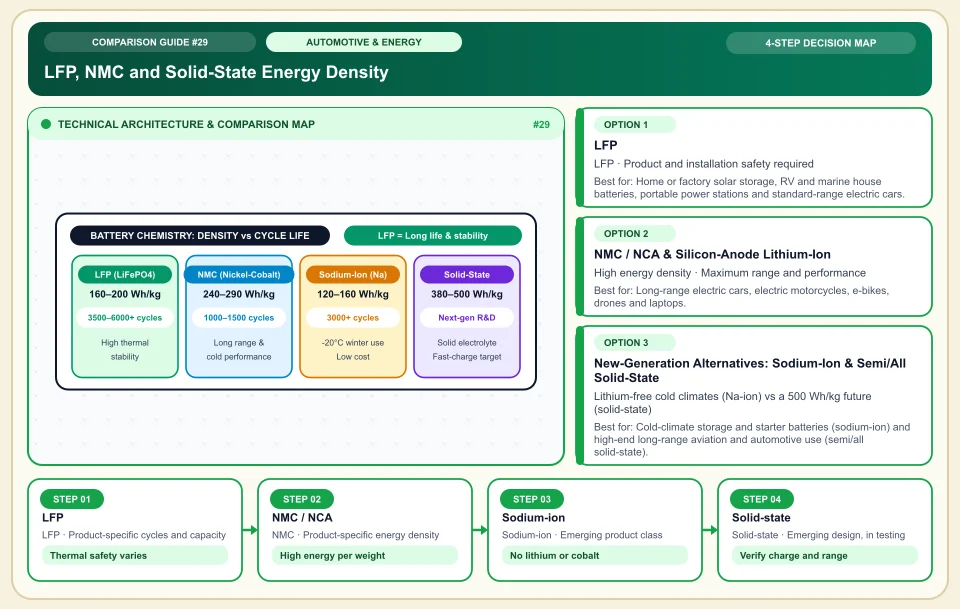
Do not pick among LFP, NMC and sodium-ion with a single safety or lifespan ranking; the application and the product documentation decide.
LFP, NMC, sodium-ion and emerging solid-state technologies differ in energy density, cycle life and supply maturity. Lab and cell data do not guarantee the life or safety of every pack. The DOE safety plan notes that incidents have been seen with LFP systems too, and that sodium-ion safety needs separate study.
For solar storage, RV and portable power, choose the chemistry on suitability, temperature, capacity, service and fire safety; do not treat LFP or any battery as nonflammable.
How to charge an EV battery depends on the model’s manufacturer guidance; daily full charging or longer life cannot be generalized across cars.
Sodium-ion cold-weather capacity depends on the cell chemistry and test conditions; one temperature or retention figure does not carry over to all products.
LFP, NMC and Solid-State Energy Density
Cell-level energy density (Wh/kg), cycle life and thermal runaway threshold compared:
LFP · Product-specific cycles and capacity
LFP cycle life and thermal behavior depend on product design and test conditions; it is not risk-free if punctured or faulty.
NMC · Product-specific energy density
NMC energy density is measured on the chosen cell design; one percentage does not hold for every LFP comparison.
Sodium-ion · Emerging product class
It uses abundant sodium salts; it can be discharged to 0V for shipping and is said to keep capacity better in freezing cold.
Solid-state · Emerging design, in testing
Solid-electrolyte designs are at different stages of research and development; energy density and fire safety must be confirmed by product testing.
An Honest Comparison of the Different Types, Pros and Cons
See the bottlenecks that marketing brochures hide, how each type works, and who each architecture suits, side by side:
1. LFP (Lithium Iron Phosphate — LiFePO4 / LMFP Cells)
Uses iron phosphate crystal (olivine structure) at the cathode instead of nickel and cobalt; lithium ions move in and out without breaking the crystal lattice during charge and discharge.
✅ Strengths (pros)
- Cycle life depends on the cell, temperature, depth of discharge and the maker’s warranty terms.
- LFP thermal behavior can be an advantage in some uses; fire risk at cell and pack level is not zero.
⚠️ Weaknesses & limits (cons)
- Its energy density is lower than NMC’s, so for the same kWh the pack is a bit heavier and bulkier.
- Low-temperature charging limits depend on the cell and BMS design; follow the maker’s limits.
Home or factory solar storage, RV and marine house batteries, portable power stations and standard-range electric cars.
2. NMC / NCA (Nickel Manganese Cobalt) & Silicon-Anode Lithium-Ion
Uses a high nickel share in the cathode (NMC 811) to maximize the energy stored per unit of weight and volume.
✅ Strengths (pros)
- NMC cells can offer high energy density in some designs; vehicle range is measured on the whole car and pack.
- Cold-weather performance depends on the cell, the BMS and thermal management.
⚠️ Weaknesses & limits (cons)
- NMC charge limits and cycle life depend on the cell and carmaker instructions.
- Its thermal runaway threshold on impact or a short is lower than LFP’s, so it needs advanced liquid cooling and an armored enclosure.
Long-range electric cars, electric motorcycles, e-bikes, drones and laptops.
3. New-Generation Alternatives: Sodium-Ion (Na-ion) & Semi/All Solid-State
Sodium-ion uses sodium ions instead of lithium; solid-state batteries replace the flammable liquid electrolyte with a solid polymer, ceramic or sulfide layer.
✅ Strengths (pros)
- For sodium-ion products, cost, cold-weather and high-current performance should be verified by cell model.
- Weight and range gains in semi-solid and solid-state designs still need to be proven at product level.
⚠️ Weaknesses & limits (cons)
- Sodium-ion’s voltage curve (1.5V–3.9V) is wider and it is heavier, so it suits stationary storage and small city cars more than long-range cars.
- All-solid-state cells are still very expensive to mass produce; wide adoption is expected to come gradually.
Cold-climate storage and starter batteries (sodium-ion) and high-end long-range aviation and automotive use (semi/all solid-state).
Side-by-Side Technical Criteria and Performance Table
The core engineering, cost and usage parameters you can compare directly when deciding:
| Criterion | LFP (LiFePO4) | NMC (High-Nickel) | Sodium-Ion (Na-ion) | Solid-State | Takeaway |
|---|---|---|---|---|---|
| Energy density | Depends on cell test | Depends on cell test | Depends on cell test | Depends on emerging product tests | Compare cell and pack mass separately. |
| Cycle life | Depends on test temperature | Depends on test temperature | Depends on test temperature | Depends on emerging product tests | Use the same state-of-health threshold and discharge range. |
| Thermal safety | Depends on pack protection | Depends on pack protection | Depends on pack protection | Depends on pack protection | Do not treat any chemistry as nonflammable. |
| Cold operation | Depends on BMS and product | Depends on BMS and product | Depends on cell design | Depends on emerging product tests | Follow the maker’s charging temperature limit. |
| Cost per unit of energy | Depends on the product quote | Depends on the product quote | Depends on supply maturity | Depends on development stage | Add up installation and warranty costs together. |
Providers and reference points
Providers, platforms or official information sources you can weigh against your own needs. The list is not a market-share ranking or a physical product test.
CATL (LFP Shenxing, Qilin NMC, Condensed Semi-Solid & Freevoy Na-ion) & BYD (Blade Battery)
- Verify the technical data and safety tests of BYD and CATL product families by the specific cell or pack model.
- They are supplied to carmakers and large energy storage (BESS) brands, not to end users as individual cells.
EcoFlow, Bluetti & Anker Solix (Portable LFP Power Stations)
- In portable power stations, cell chemistry, charging time and warranty should be verified for the chosen model.
- Portable unit weight varies with battery capacity and extra hardware.
Pylontech, Dyness & EVE Energy (Stationary Rack-Mount LFP)
- EVE prismatic LFP cells and Pylontech/Dyness cabinet batteries are widely used in home solar and RV systems.
- For cell quality, traceability and warranty terms, verify the maker’s certification and the seller’s documents.
Category 3: Automotive, Mobility & Energy Technologies
Hybrid powertrain architectures, home solar systems, winter tire tests, ECE 22.06 helmets and LFP/NMC battery chemistries.
Sources and review method
The DOE energy storage safety plan describes the limits of chemistries including LFP and sodium-ion. Life and safety should be confirmed with product tests at cell and pack level.
Sources checked:
- U.S. DOE — Energy Storage Safety Strategic Plan ↗
No chemistry, including LFP and sodium-ion, comes with a safety guarantee.
Frequently Asked Questions
Should I get a gel battery or a LiFePO4 (LFP) lithium battery for my RV or boat?
Compare gel and LFP batteries under the same conditions for usable capacity, weight, cycle life, temperature and protection electronics. A fixed cost or lifespan advantage cannot be applied to every product.
When buying prismatic LiFePO4 cells cheaply, what is the difference between "Grade A" and "Grade B"?
Cell grading can vary by seller. Do not treat a QR code alone as proof of capacity, safety or a new product; ask for the batch documentation and an independent test report.
What is an LMFP (lithium manganese iron phosphate) battery?
LMFP is a chemistry family that adds manganese to the LFP cathode. Energy density, cost and safety results should be confirmed by cell design and test conditions.